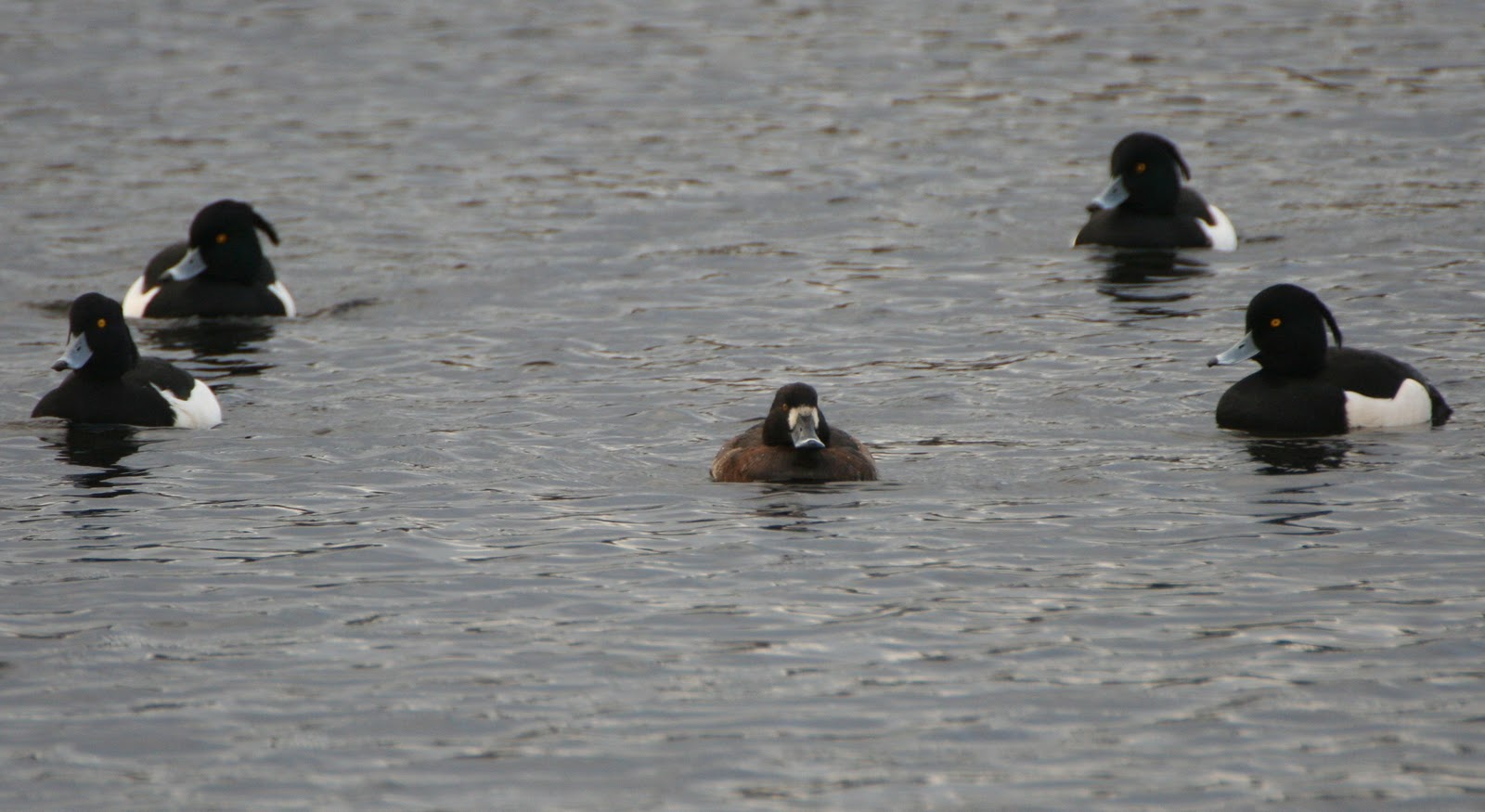
I could walk blindfold around Cwmbran Boating Lake and still come up with a reasonably accurate species list, but yesterdays chesse and pickle sandwich visit was an exception. Not one, two, three or four but no less than 46 pochard were counted with a couple of tufted duck thrown in good measure. So unusual was this occurrence that both species of diving duck represent new records of the site for me. The birds were very unsettled and flighty so much so that 19 of the birds left the lake during my brief visit.
Promoting observation, free range exploration, sense of place and citizen science through the field notes of a naturalist.
Wednesday, 23 February 2011
Sunday, 20 February 2011
Return of the hybrid
The Canada Goose x Grey Lag Goose hybrid blogged by yours truly on 7 February 2010 was present again today at Bryn Bach Park ,in with about 42 Canada's.
At Machine Pond exactly one week following the first Gwent Goosanader Winter Roost Survey were four of the target species. Eventually took off in a north westerly direction.
Saturday, 19 February 2011
Scaup face
In amongst a group of about 24 tufted duck at Beaufort Ponds this afternoon was this jobbie. On facial pattern only it would have been easy to have scribbled this one down as a female scaup but on closer inspection it's just a tuftie. Note large black tip to bill, pale bill band and a touch of a tuft. Unless you think differently?
Also present were three mute swan one of which was ringed - probably one of Luke's from Bryn Bach Park.
Friday, 18 February 2011
Sunday, 13 February 2011
Gwent Goosander Winter Roost Survey 2011
Was a tad nippy and wet as I did my bit for the well organised Gwent Goosander Winter Roost Survey 2011 this evening at Dunlop Semtex Pond. Nice group of mainly male tufted duck and a couple of pochard, but star of the visit was a water rail. Oh! by the way no goosander.
Wednesday, 9 February 2011
What is this?
Came across these blobs of jelly in the middle of a meadow at Llandegfedd Reservoir recently. But what are they? To me the jelly looks like undeveloped frog spawn. Any ideas?
Sunday, 6 February 2011
There's a pretty polly
There's been talk of a ring necked parakeet in the Cwmbran area for some weeks and only a few days ago I was told a bird had been regularly coming to roost in Oakfield Park, Llantarnam. This mornings rather damp visit to Cwmbran Boating Lake was in the hope of a wind blown seabird rather than a non-native. No wind blown kittiwakes amongst the usually crop of common wildfowl, but disturbed this parakeet that was ground feeding. This bird was very flighty and vocal moving between the tops of large trees before flying out of sight.
After an hour at the boating lake I moved on to Llandegfedd Reservoir. Conditions were so choppy that it was almost impossible to make out any wildfowl, although good numbers of gull were clearly visible. Green pool hide provided the best birding opportunities with small counts of wigeon and teal taking advantage of the calmer waters.
Saturday, 5 February 2011
Thursday, 3 February 2011
Staying local
Stayed local today with a walk around Lasgarn wood near Abersychan. This woodland is where I cut my naturalist teeth as a youngster, so was refreshing to revisit this morning. Sadly a couple of wych elm that I look forward to seeing in flower each spring are now dead, but on the positive side they are supporting a healthy population of velvet shank (Flammulina velutipes) fungi. Elsewhere flushed a woodcock from close to a now scrubbed over midden pit, a legacy of a long gone farmstead.
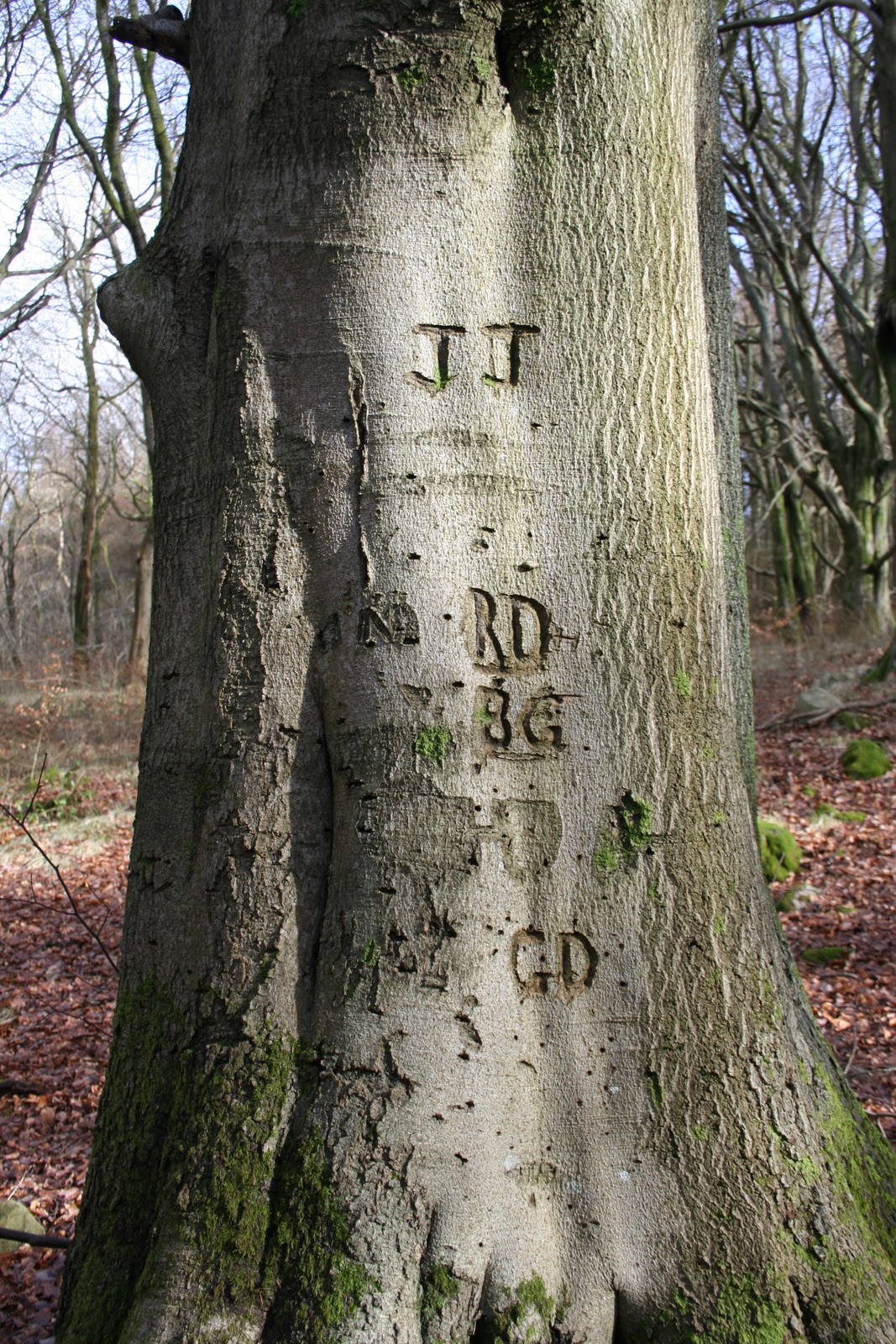
The smooth bark of beech trees lend themselves well to penknife name carvings. This, I seem to remember, was commoner in days of my youth when carrying a penknife was part of the toolkit of all aspiring boy scouts, alongside the ever ready Observers Book of Birds. I suppose some purists would view this activity as vandalism, but clearly it has done the tree little harm and to me this is symbol of a time when local people used the woodlands for more than just riding your motorbike through. In this respect these tree initials are as much part of our cultural heritage as a miners lamp or spoil tip.
Wednesday, 2 February 2011
The Bohemian waxwing then and now
A few days leave (use 'um or lose 'um) and today was shopping day. First stop was a visit to Next Clearance on the Mendalgief Retail Park in Newport, scene of a much watched party of waxwing some weeks ago. Who was it that told me that a hapless security guard misread the presence of birders with cameras and long lenses for visiting paparazzi on a mission to photograph an Oscar nominated celeb dropping in on Pets at Home for some doggy chocs?
From Newport we made our way to Chepstow. On the approach to the town we paused in traffic just long enough to witness a party of c20 waxwing fly from north to south over the road and adjacent Texaco garage into the heart of the housing estate beyond. This sighting suggests birds reported from the same area around the beginning of the year are still around. Just goes to show even on a shopping jolly there's things to see.
Tuesday, 1 February 2011
What is being constructed at Ynys y fro Reservoir?
Called into Ynys y fro reservoir today but didn't venture around the lower lake due to level of construction work. What is going on? Looks like a large glass fronted building.
Moderate numbers of waterfowl on the upper lake including c130 coot, 2 little grebe, 50+ pochard, 22 tufted duck, 2 mute swan, and a female goldeneye.
Gulls were also plentiful, congregating on the frozen sections of both parts of the reservoir. Once again an adult black headed gull was clocked sporting some 'bling', probably of foreign origin.
Monday, 31 January 2011
I'm EX30139 remember me?
Now heard back from BTO concerning the above ringed black headed gull photographed at Bryn Bach Park in October of last year. Bird was ringed as a nestling on 7 June 2010 at Hosehill Lake, West Berkshire (SU6469). This represents a movement of 158km from ringing site.
Friday, 28 January 2011
Best bib and tucker
Black headed gulls tend to get their summer plumage early, but this one at Cwmbran Boating Lake this lunchtime was way in advance of any other gull present.
Other noteworthy birds included this tree creeper that was rather reluctant to turnaround and a fleeting glimpse of another black headed gull carrying a colour ring either red or orange.
Thursday, 27 January 2011
Red letter day for vc 35 coleoptera
Would you believe it after my approving rant about an item on Gwent Levels beetles in the last edition of The Coleopterist there's more. The December 2010 issue of this brilliant little journal has just arrived containing a report of interesting beetle records from Wales by Brian Levey. And to my utter joy theres a list of Notable b species from Gwent Wildlife Trusts Cwm Merddog reserve near Ebbw Vale and even better still a record of the rove beetle Pella limabta from Blaenavon.
Sunday, 23 January 2011
I knew that bit of Halifax bomber fuselage would come in handy
Waunafon bog is drying out, now more grassland than wetland due to some very effective drainage work alongside the pit road. So with the bog snorkeling cancelled I went in search of short-eared owl pellets.
I've collected pellets at this spot before as the aforementioned vole munchers seem keen on the fence posts that surround the wreckage of the Halifax bomber that was lost in the bog way back when. A bit of hands and knees searching amongst the molinia and assorted aviation memorabilia delivered the goods. The images above show a small handful of indigestible bits both intact, and teased apart to reveal various mammal bits and pieces. Thanks to Halifax bomber fuselage for proving the backdrop.
Tuesday, 18 January 2011
More of the same but slightly different
Following the many supportive and encouraging comments about my 'Portrait of a Short-eared owl in motion' I visited the Cwmbran waxwings in the hope of obtaining more quality images. No berries are left on the trees but plenty of windfall fruits provide rich pickings hence a group of 30+ birds were feeding readily on the ground often alighting en masse.
Sunday, 16 January 2011
My photographic prowess strikes again
It's around this time of year that short eared owl's appear on our hillsides, and historically Waun afon bog just north of Blaenavon has been as good a spot as any to see these splendid birds. An opportunist late afternoon visit was rewarded with two birds hunting on the bog and adjoining hillside. As you can see from the image the weather and light conditions were not conducive to good photography but I think theres enough in the shot to confirm its identity. Apologies to migraine sufferers!
Earlier four goosander at Cwmtillery Lake was a bit of a surprise. Otherwise six tufted duck, ten Canada goose, two flyover goosander and c25 goldfinch were at Machine Pond (aka Parc Nant-y-Waun) and at Dunlop Semtex Pond were ten tufted duck and two pochard.
There was an interesting spectacle at Machine Pond with large accumulations of dredged Nuttalls pondweed on the south side of the pond, with a lady actively raking the vegetation away from the pond edge to apparently spread around the base of some nearby conker trees - why?
Tuesday, 11 January 2011
Sods law
A recent lunchtime sortie to Cwmbran Boating Lake was unremarkable but for a few goosander and a cormorant. However in with a group of eight Canada goose was one that was discernibly smaller with a darker breast and dusky white facial markings. It wasn't until I did a touch of web research did I realise this bird may have been one of the many subspecies doing the rounds. The best match appears Taverners Canada goose and in this respect note a bird recorded from Llangorse last year. So the aim today was 'get back down there' and take some pictures. And yes you guessed it there were only seven geese on the lake today with the target bird nowhere to be seen.
As compensation there were upwards of 25 waxwing stripping the now rapidly depleting berries in Cwmbran.
Sunday, 9 January 2011
Poor dab
Found this common shrew frozen stiff on the Magor Marsh boardwalk today. There's fifteen species of shrew in Europe split into groups of white and red toothed, as you can see the common shrew is a member of the latter group.
On the lake today were six gadwall, two little grebe, several teal along with mallard, moorhen, heron and two mute swan, with a further 36 in an arable field close to the reserve. A couple of reed bunting were noted on the way back.
Not too much to report from Magor Pill other than good numbers of both waders and wildfowl with some impressive flocks of dunlin, also skylark and about 50 linnet feeding on the saltmarsh.
Thursday, 6 January 2011
Waxwing in the Valley of the Crows
Travelling through Cwmbran earlier this week I noticed several ornamental rowan trees supporting a plump juicy crop of white berries just awaiting a flock of marauding waxwing. A quick visit today turned up trumps, but just one individual of the said visitors from colder (or not so colder) climes was present. Difficult to get a decent photo when you have to poke your lens skyward in a residential area! See Gwent Ornithological Society sightings page for directions.
Tuesday, 4 January 2011
Monday, 3 January 2011
Got a light mate?
A report of 31 Canada goose at ice bound Bryn Bach Park got me on the road mid morning in the hope of a bit of ring spotting. Once again I dipped out as no geese were present, back then to Dunlop Semtex Pond. Thanks to the efforts of litter bugs there was no shortage of items to keep the local industrious Herring gulls occupied. This bird was entertaining itself with a discarded lighter.
Further to my recent blog enter about colour ringing, a touch of web research has turned up a good number of gull study groups both in the UK and all over Europe. I will add links to the best sites in due course.
Wednesday, 29 December 2010
Inform BTO
Its only rarely you get the opportunity to view the legs and feet of gulls and wildfowl. This recent cold snap has done the trick by hosting those usually submerged 'pins' from the icy depths to a position where they can be checked for Ratner style jewellery. At Bryn Bach Park yesterday there were several hundred assorted gulls along with a smaller number of coot, mallard and mute swan all standing on the frozen lake. The two ringed mute swan blogged on 5 December were joined by three other ringed birds of consecutive numbers. Now present are numbers ZY4632-33-34-35-36. Also noted was the above coot with ring number GC60061.
For gulls more than wildfowl ringers will certainly get more 'bang for their buck' if they use Darvic or colour rings in conjunction with the standard metal rings. With optical advances these days reading and photographing birds with rings is easier than ever but often still requires the bird to be viewed from several angles to read a full number. Ringers would get back more data if colours and larger numbers were available to view in the field, after all plotting the movements of birds is what ringing is all about and anything that enhances this must be worth it. By example the two ringed herring gull at Dunlop Semtex Pond recently were too distance to read a small number on a discoloured metal ring but with a colour ring things may have been different.
Tuesday, 28 December 2010
Gulls on ice
There were a good number of gulls on offer at Dunlop Semtex Pond yesterday. The majority were black headed, but also included the above common, herring and lesser black backed. Two herring gull (one adult and one first winter) were carrying metal rings but were too distance to read numbers.
Subscribe to:
Posts (Atom)