Promoting observation, free range exploration, sense of place and citizen science through the field notes of a naturalist.


Sunday, 20 March 2011

Chiff-chaff-chiff-chaff-chiff-chaff.................


Today was the day of the chiffchaff and not much else if I'm perfectly honest. First stop was Magor Pill with nothing of significance to report other than a small party of LEARN students on a birding field visit. Things improved slightly at Magor Marsh with a cettis warbler and several small tortoiseshell butterflies.


On the way back decided on a little detour to have a look at Bulmore Lakes on the Celtic Manor pitch and putt course. Not sure on public access so had to put up with a road side view - does anyone know if there's a public right of way to the lakes? Apart from a lot of middle aged men wearing silly brightly coloured trousers I could just make out four great crested grebe, four greylag geese and about 26 Canada geese.


No sign of any toads at the moment but Newport City Council are doing their best to raise the profile of road mortality and biodiversity generally -they've even managed to get the road closed bet thats gone down well!

Finally today's chiffchaff totals were as follows:

Magor Pill -1
Magor Marsh - 6+
Christchurch Hill, Caerleon - 1
Bulmore Road, Caerleon - 3+

Friday, 18 March 2011

'Whats this Dad?'


'What the hell is that. Daaaad!' was the cry from my sons bedroom last night. On arrival I found this western conifer seed bug (Leptoglossus occidentalis) trapped in the bottom of a glass tumbler competing with the dregs of a long gone cherry Tango.

This squash bug is a native of north America but since its introduction to Europe in 1999 has spread rapidly. As with the example above its a large bug readily attracted to light and therefore isn't fussy about coming indoors. For those of you with a copy of A Photographic Guide to the Shieldbugs and Squashbugs of the British Isles: Evans and Edmondson (2005), forget it, you won't find  mention of it - ooops!

Its a tick!


If I were a year lister, which I'm not, after yesterdays visit to the River Usk at Llanwenarth I'd be sharpening my trusty HB pencil in readiness to insert another nice neat symmetrical tick in the BTO's Long List of British Birds booklet, you know the one we all have in our Christmas stocking each year. Because yesterday produced at least three singing chiffchaff on the Usk to complement the one outside my front door. Other bird notables down by the riverside were two pair of goosander, two calling curlew, dipper and mute swan.


Away from the ornithological delights of this fine river there was a wealth of other biodiversity to warm the cockles of ones heart. Otter spraints were evident in several places accompanied by some fresh muddy footprints. There was also a smattering of wild daffodils and some lady smock just about to burst forth.The extensive areas of shingle banks were also ideal for compulsive stone turners such as myself, with some early shingle beetle activity on view including Bembidion tetracolum.


Wednesday, 16 March 2011

Early evening in a clear-fell


Wentwood is apparently the largest ancient woodland site in Wales so you can't blame a couple great grey shrike wanting to spend some time there. However yesterday evenings stroll was an attempt to find one of the same brand in a woodland other than Wentwood.

High above Pontypool on the southern side of the Crumlin Road is a large imposing conifer plantation the upper section of which is adjacent to Mynydd Llwyd and was clear-felled about 12 months ago. The challenge nonetheless was locating the site without getting lost. With the aid of a trusty Landranger map the best I could do was to park just off Mynydd Maen common and walk. After a modest half an hour or so avoiding a quizzical herd of Welsh Mountain Blacks and the rutted terrain courtesy of our off road friends I arrived at the said clear-fell. Apart from a solitary singing dunnock and a distant skylark it was hardly worth the effort. But all was not lost as I picked up a male hen harrier as it left the moorland of Mynydd Llwyd to disappear over the valley to Mynydd Llanhileth. The only other scrap of life to trouble the Valley Naturalist note book was a good population of the little ground beetle Notiophilus biguttatus.


There were some smashing examples of dry stone walls on offer as I returned to base and a fly over party of about 8 fieldfare rounded the evening off.

Monday, 14 March 2011

Breeding season begins here


It seems the spring like weather has spurred some birds into early nest building. At Bryn Bach Park this evening there were at least two separate great crested grebe nests and a number of coot doing things with bits of vegetation. Nothing much to shout about on the summer visitor front as I'm still awaiting my first chiffchaff, wheatear and sand martin although whilst walking the black labs this morning at Tirpentwys Local Nature Reserve thought I heard a wood warbler - obviously mistaken! Back to Bryn Park and the hybrid greylag x Canada goose was in amongst about 46 Canada's most of which were paired up. Otherwise c40 tufted duck, 5 pochard and a single cormorant. Flying visits to Beaufort Ponds and Dunlop Semtex Pond produced broadly the same wildfowl assemblage but in smaller numbers, the only variable was at Beaufort where there was a pair of mute swan and a calling little grebe.

Saturday, 12 March 2011

What vented this?


Yes this is a bird dropping but from what species? While you're pondering your response I'd like to tell you about my trip around the glorious Cefn garn yr erw landscape this morning. An early wheatear failed to show but skylark song was widespread, other notables included a male reed bunting in song and a single grey heron. However the most pleasing sight was the return of lapwing to their breeding site on the hillside above Garn Lakes Local Nature Reserve - eights birds in total.

Thursday, 10 March 2011

Another ringed CANGO


This is my second ringed Canada goose from Cwmbran Boating Lake following on from the one noted in early October last year. Interestingly, the ring number on this bird is only one digit different to the Llangorse Lake ringed October bird.

Monday, 7 March 2011

British mosses


Spiky Bog-Moss (Sphagnum squarrosum)


Common Haircap (Polytrichum commune var. commune)

Left home yesterday lunchtime to the distant sound of a chainsaw in action - nothing like an improvement in the weather to bring out the lumberjack in you! Destination was one of my local patches known as 'The British', named after the now long trashed British Ironworks. I arrived just in time to witness a Skoda saloon climb to the top of a large spoil tip, turn, descend, and rejoin the public highway. Didn't notice a valid tax disc as it passed me, but I'm sure they'll have had one.

The British is a playground of accessible brown and green space for local communities, valued by some abused by many. Nonetheless early successional plant communities sit in harmony with ancient woodland habitat making it a naturalist's delight. I'm trying to get into bryophytes but as a difficult group I need to put in some fieldwork to build confidence so today's objective was photography and voucher specimens. 

Of the few I was able to identify straight off were a number of sphagnum species including spiky, papillose and flexuous bog-mosses. There were some impressive yellow meadow ant mounds capped with common haircap. I took samples of about twenty other mosses now awaiting a rainy evening to identify. Birds were thin on the ground but for a party of about 40 fieldfare and a half a dozen or so redwing.


A very enjoyable couple of hours ended where it began with another form of countryside abuse, this time a numb skull dressed in full urban gorilla attire discharging his air gun with gay abandon. 

Monday, 28 February 2011

Death of a nest box colony - update


I've heard from Steve Carter who's done some sterling research work on the now defunct nest box colony on the outskirts of New Inn by thumbing through some Gwent Bird Report back issues. Seems that this colony was in its prime during the 1970s onward, but the most interesting fact is that it once supported 40 tree sparrow nests. Begs the question, is there still a remnant population in the area?

Sunday, 27 February 2011

Rooftop gulls are back


Having safely transferred a trolley full of monosodium glutimate and trans-fats to the car it was time for a poke around. A modest count of 20+ tufted duck and Lukes three ringed adult mute swan were noted on Beaufort Ponds. At Machine Pond there were three great crested grebe and a few tufted duck.

There were no gulls on the industrial buildings near Dunlop Semtex Pond during Goosander Gwent Winter Roost Survey just two weeks ago. Today however both the lesser black backed and herring gulls were back in numbers, many appear to have already taken up territory on the sedum roofs.

Saturday, 26 February 2011

Death of a nest box colony


In a woodland just outside New Inn, near Pontypool was a nest box colony. In its heyday the fortunes of the birds that bred in these wooden boxes were documented annually in the Gwent Bird Report. Sadly the colony is no more, I know not why, all that remains of what once supported the likes of redstart and pied flycatcher are rotting remnants.


There were certainly some very good signs on the woodland floor that something was a stirring. Dogs mercury and bluebell were pushing forth and this queen Bombus terrestris was searching for an underground niche in which to build its nest. This widespread bumblebee is one of the earliest to appear from February onwards, this one was displaying a number of ticks.


Wednesday, 23 February 2011

Where did this lot come from?


I could walk blindfold around Cwmbran Boating Lake and still come up with a reasonably accurate species list, but yesterdays chesse and pickle sandwich visit was an exception. Not one, two, three or four but no less than 46 pochard were counted with a couple of tufted duck thrown in good measure. So unusual was this occurrence that both species of diving duck represent new records of the site for me. The birds were very unsettled and flighty so much so that 19 of the birds left the lake during my brief visit.

Sunday, 20 February 2011

Return of the hybrid


The Canada Goose x Grey Lag Goose hybrid blogged by yours truly on 7 February 2010 was present again today at Bryn Bach Park ,in with about 42 Canada's.

At Machine Pond exactly one week following the first Gwent Goosanader Winter Roost Survey were four of the target species. Eventually took off in a north westerly direction.

Saturday, 19 February 2011

Scaup face


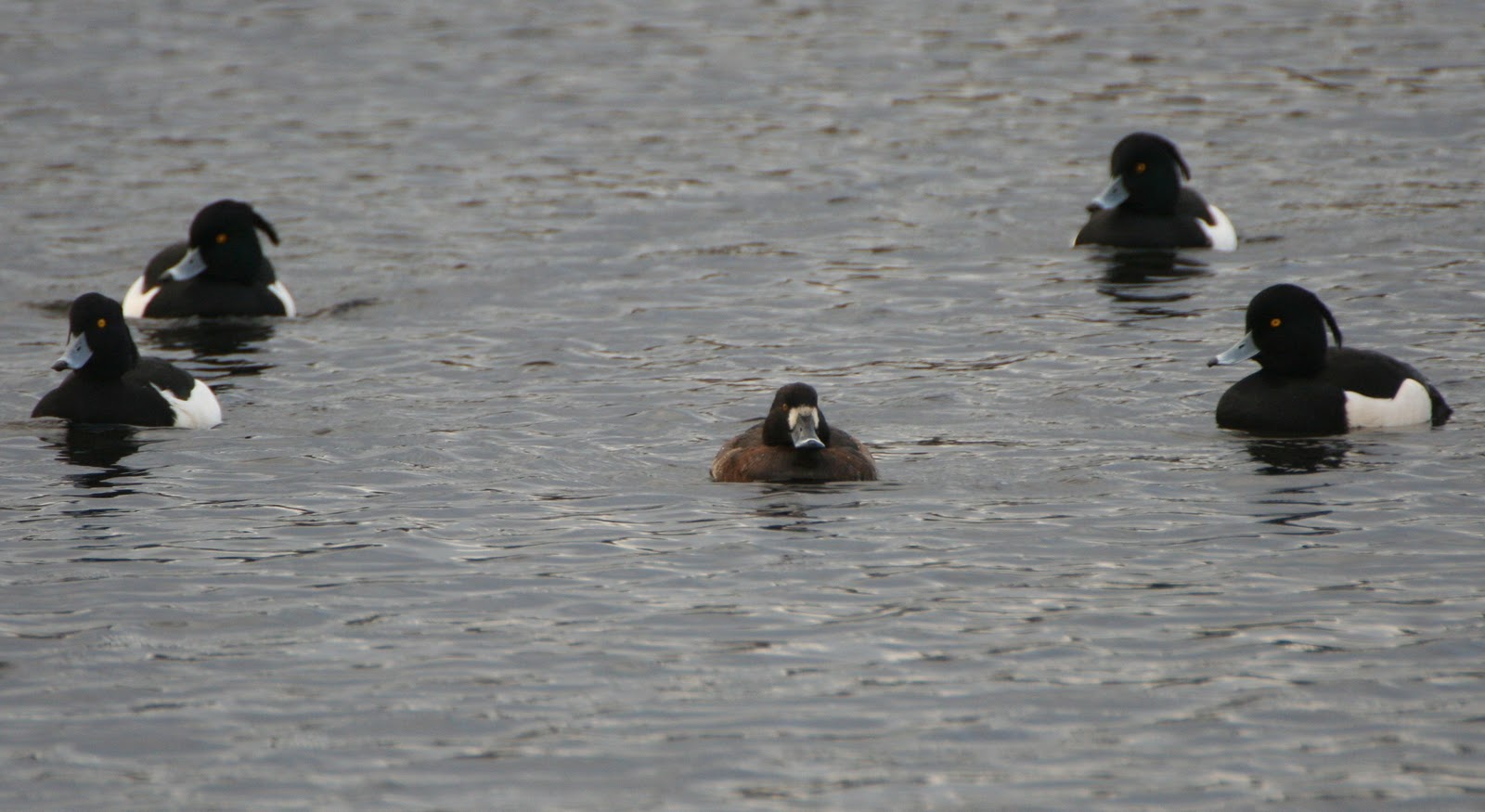
In amongst a group of about 24 tufted duck at Beaufort Ponds this afternoon was this jobbie. On facial pattern only it would have been easy to have scribbled this one down as a female scaup but on closer inspection it's just a tuftie. Note large black tip to bill, pale bill band and a touch of a tuft. Unless you think differently?

Also present were three mute swan one of which was ringed - probably one of Luke's from Bryn Bach Park.


Sunday, 13 February 2011

Gwent Goosander Winter Roost Survey 2011


Was a tad nippy and wet as I did my bit for the well organised Gwent Goosander Winter Roost Survey 2011 this evening at Dunlop Semtex Pond. Nice group of mainly male tufted duck and a couple of pochard, but star of the visit was a water rail. Oh! by the way no goosander.

Wednesday, 9 February 2011

What is this?


Came across these blobs of jelly in the middle of a meadow at Llandegfedd Reservoir recently. But what are they? To me the jelly looks like undeveloped frog spawn. Any ideas?

Sunday, 6 February 2011

There's a pretty polly


There's been talk of a ring necked parakeet in the Cwmbran area for some weeks and only a few days ago  I was told a bird had been regularly coming to roost in Oakfield Park, Llantarnam. This mornings rather damp visit to Cwmbran Boating Lake was in the hope of a wind blown seabird rather than a non-native. No wind blown kittiwakes amongst the usually crop of common wildfowl, but disturbed this parakeet that was ground feeding. This bird was very flighty and vocal moving between the tops of large trees before flying out of sight.


After an hour at the boating lake I moved on to Llandegfedd Reservoir. Conditions were so choppy that it was almost impossible to make out any wildfowl, although good numbers of gull were clearly visible. Green pool hide provided the best birding opportunities with small counts of wigeon and teal taking advantage of the calmer waters.

Saturday, 5 February 2011

Great grey skies

                                          Fuerteventura 2010


                                         Wentwood 2011

Thursday, 3 February 2011

Staying local


Stayed local today with a walk around Lasgarn wood near Abersychan. This woodland is where I cut my naturalist teeth as a youngster, so was refreshing to revisit this morning. Sadly a couple of wych elm that I look forward to seeing in flower each spring are now dead, but on the positive side they are supporting a healthy population of velvet shank (Flammulina velutipes) fungi. Elsewhere flushed a woodcock from close to a now scrubbed over midden pit, a legacy of a long gone farmstead.


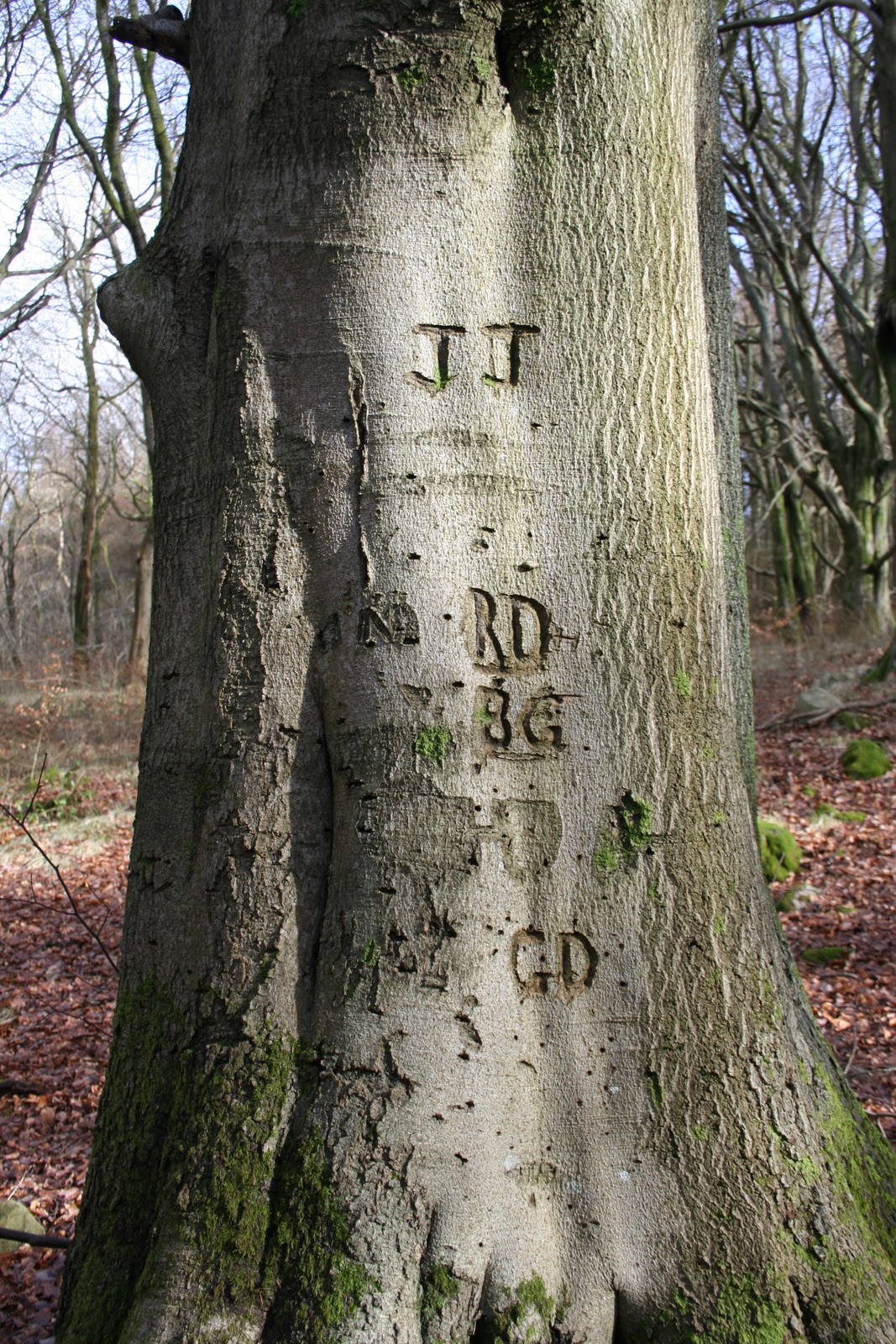
The smooth bark of beech trees lend themselves well to penknife name carvings. This, I seem to remember, was commoner in days of my youth when carrying a penknife was part of the toolkit of all aspiring boy scouts, alongside the ever ready Observers Book of Birds. I suppose some purists would view this activity as vandalism, but clearly it has done the tree little harm and to me this is symbol of a time when local people used the woodlands for more than just riding your motorbike through. In this respect these tree initials are as much part of our cultural heritage as a miners lamp or spoil tip. 

Wednesday, 2 February 2011

The Bohemian waxwing then and now


A few days leave (use 'um or lose 'um) and today was shopping day. First stop was a visit to Next Clearance on the Mendalgief Retail Park in Newport, scene of a much watched party of waxwing some weeks ago. Who was it that told me that a hapless security guard misread the presence of birders with cameras and long lenses for visiting paparazzi on a mission to photograph an Oscar nominated celeb dropping in on Pets at Home for some doggy chocs?


From Newport we made our way to Chepstow. On the approach to the town we paused in traffic just long enough to witness a party of c20 waxwing fly from north to south over the road and adjacent Texaco garage into the heart of the housing estate beyond. This sighting suggests birds reported from the same area around the beginning of the year are still around. Just goes to show even on a shopping jolly there's things to see.

Tuesday, 1 February 2011

What is being constructed at Ynys y fro Reservoir?


Called into Ynys y fro reservoir today but didn't venture around the lower lake due to level of construction work. What is going on? Looks like a large glass fronted building.

Moderate numbers of waterfowl on the upper lake including c130 coot, 2 little grebe, 50+ pochard, 22 tufted duck, 2 mute swan, and a female goldeneye.


Gulls were also plentiful, congregating on the frozen sections of both parts of the reservoir. Once again an adult black headed gull was clocked sporting some 'bling', probably of foreign origin.


Related Posts Plugin for WordPress, Blogger...