Promoting observation, free range exploration, sense of place and citizen science through the field notes of a naturalist.


Saturday, 21 May 2011

Any ol' patch will do


Myathropa florea

Out for less than three quarters of an hour and look what I bagged. At this time of year there's an overwhelming amount of wildlife to watch, record and photograph. On this occasion I found patch of ox eye daisy waited and  photographed. Less than 10 metres from my car, so no strenuous walking or the need for army fatigues and jack boots to yomp miles across rugged terrain to access wildlife its there all around us and accessible.

There are well over 250 species of hoverfly in Britain and as usual the vice county hardly features on the distribution maps. There must have been 10 species or more visiting this patch of wildflowers. Its so easy to record so bloody well get out there and put this forgotten corner of Wales on the recording map!


Eristalis horticola


 Eristalis intricarius

Eristalis tenex

Volucella pellucens

Wednesday, 18 May 2011

More gulls different place


Going about my business in Newport this evening noted another colony of breeding gulls on the roof tops of an industrial estate opposite the Transporter Bridge. Pulled in outside the Ship and Pilot pub complete with a crew of drunken seamen singing sea shanties and a number of youths with aggressive looking dogs to take some pics. This colony, just like others I know of in north Gwent, appear to like asbestos corrugated roofed buildings with protruding bolts on which to anchor their nests.


Sunday, 15 May 2011

Fallible - help needed!


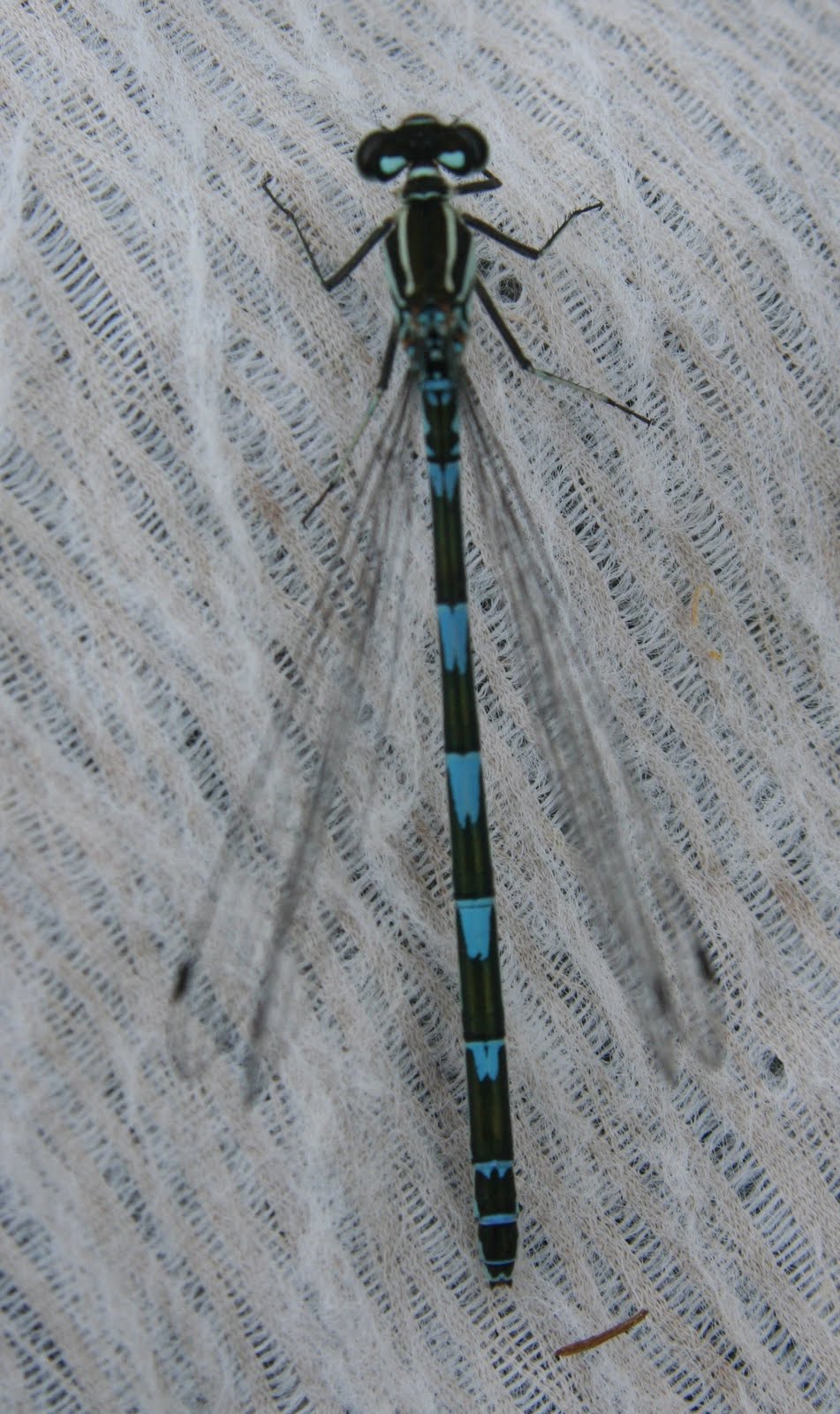
Further to today's lengthy post about variable damselfly I now need to confess that I think the posting to be erroneous. Having consulted various field guides its appears the only reliable way of separating variable from azure damselfly is the deeply lobed nature of the prothorax on the variable. You will note that the prothorax in the photo is not deeply lobed therefore making it azure. However I believe the abdominal markings are akin to variable. 

Can anyone put this to bed please??

Variable damselfly - on the wing now!


I had a hunch I'd seen variable damselfly (Coenagrion pulchellum) in a meadow close to the Monmouthshire and Brecon Canal between Newport and Cwmbran. After a search of about 20 minutes I was rewarded, and thanks to some timely cloud cover the target female damselfly remained still for a good number of record shots.

I knew this species was present in the vice county but I'd never really made the effort to track it down and given that blue damselflies as a group can be tricky to identify it remained a personal enigma. The above distribution map is taken from the National Biodiversity Network Gateway website (thanks to NBN) giving a flavour of its lowland distribution. Its always worth checking with SEWBReC for possibility of more records though.


Field mark tip: Distinctive mercury mark to upper abdomen.


Field mark tip : Increasing amounts of blue on each segment from posterior upwards. Also note visible notch to each blue patch.

Friday, 13 May 2011

Adaptability


This grey heron was again present at Llantarnam Ponds, spending a lot of time in a swan like posture taking fish at frequent intervals.

Wednesday, 11 May 2011

Rug pulled from under one's feet


I reached for the storage box marked 'entomological stuff' and there under the pith helmet, khaki shorts and pipe complete with half ounce of rough shag was my trusty sweep net. With a grin of reassuring satisfaction I assembled the net to handle and shook out the dried vegetational remains of last year's successful campaign. Placing the net comfortably on the back seat I made my way to Magor Marsh for some serious, sustained sweep netting. And I wasn't disappointed, as if awakened from a deep sleep refreshed for action the net swung into action to the left to the right cutting through the vegetation in the single minded pursuit of bagging an assortment of biological data.

The day therefore was all about inverts and within a mixed bag of thingamajigs was the first broad bodied chaser dragonfly of the year some short winged conehead and this lil' beauty. This is a ground beetle named Demetrias imperialis a Nb species swept from the hay meadow part of the reserve. When confronted with something different I tend to log on to the National Biodiversity Network website to get a feel for its national distribution, and surprise surprise not a single dot to besmirch our principality. Next stop then was the local records centre (SEWBReC) just in case they had records before I started to blow the 'new record for Wales trumpet'. Disappointingly they had records from Magor Marsh (2005) and Calidcot (2007). Drat Julian Branscombe's vision in contracting Dr Peter Kirby to survey the invertebrates of Gwent Wildlife Trust's key reserves in 2005- drat! drat! drat!

Saturday, 7 May 2011

More under-recorded coleoptera


Now is the time to dig out the macro lens, extension tubes etc, and get out and start recording and photographing the invertebrates of Gwent. Any patch of rank vegetation, pond or river margin will harbour hidden treasures. Gwent is so under recorded its embarrassing.

A recent visit to Llantarnam Ponds produced the beetle Oedemera nobilis and the reed beetle Donacia vulgaris. Also a male and female beautiful demoiselle damselfly, and also large red and azure damselfies. Keep looking!

Wednesday, 4 May 2011

Damselflies are starting to show


Its been a few months since I last paid Cwmbran Boating Lake a visit. Showing well around the impressive and maturing stands of yellow flag iris and pendulous sedge were the first odonata of the year in the shape of blue tailed and common blue damselfies. A pair of mute swan were relatively new additions to the lake to join dozens of mallard, many with young, and twelve Canada geese. On leaving I struck up a conversation with a gentleman running a model boat across the lake he said that last Summer, for about a couple of weeks, there were two Egyptian geese on the lake and from his description I have no reason to doubt his identification.. Oh, and three swift over Cwmbran earlier.

Monday, 2 May 2011

Suppressed!


There's been some cyber blog space devoted to suppressing recently so I thought it high time I came clean about my own suppressing activities. Last week I was surprised to find this roosting on my outside light. Now I debated the merits of going live with the news and the possible little earner derived from charging a fiver to view from the kitchen window, but having a queue of birders stretching down the road just wouldn't cut the mustard with the neighbours. So I'm rather ashamed to say I kept the news to myself and immediate family only, but for a visit from a Springwatch camera team.  Now with the mega tick moved on ( to Chepstow or Neath ) I can safely announce to all and sundry, and apologies to all Gwent/Glamorgan twitchers for keeping mum -watch forthcoming Springwatch for report. Full description will be submitted to rarities panel in due course with follow up article in next years Gwent Bird Report.

Now I know what you're thinking he's been working too hard of late and needs a holiday or even professional help. My neighbour asked how I was keeping after he saw me positioning the cooking ingredient and taking a photograph of it, he quickly retreated into his house locking the door behind him.!   


Sadly no dotterel once again


Another attempt for dotterel on the Blorenge ended in abject failure. Had to be content with some impressive stands of hares tail cotton grass (Eriphorum vaginatum) and a calling red grouse. A rather shabby violet ground beetle (Carabus violaceus) was noted and the usual assemblage of upland birds were evident on return including stonechat and increased numbers of singing whinchat. I live to fight another day!


Sunday, 1 May 2011

Nice record but not the first


This micro moth is Grapholita lunulana photographed at Dunlop Semtex Pond on 24 April this year. Micro moths can be a touch ticky on times some requiring genitalia examination to separate but this one is distinctive enough and with the help of the UK Moths site it was narrowed down. Nonetheless I dropped Sam Bosenquet an email in his capacity as the mirco moth recorder for the Watsonian vice county of Monmouthshire and he has confined it is in fact Grapholita lunulana. This is the second county record the first was from Dixton Embankment, Monmouth in the 1980s.

Saturday, 30 April 2011

Today's guest publication


Grabbed hold of a copy of Britain's fastest growing waterways publication Towpath Talk  today on the way to a few watery places - no surprise its the fastest growing publication as its free! First stop was Ynys y fro Reservoir which was more of a slow moving turnaround rather than a stop because it seemed that every bloke in Gwent with a fishing rod had descended on this birding no go zone. Down then to the Mon and Brecon Canal at Malpas. A nice little walk  down to the M4 was full of common wildfowl including several recently fledged moorhen and a sitting mute swan. There was also some exciting  'look but you can't touch' views of Gwastad Mawr. Does anyone monitor this site?


By contrast Pant yr eos Reservoir had only one fisherman who left shortly after I arrived probably because my mutterings containing frequent swear words and must have carried readily across the reservoir. On the bird front there wasn't much to shout home about apart from a single male tufted duck, a singing redstart and some juvenile grey wagtail so I turned my attention to creepy crawlies of which there was plenty to see. Here's a list of notables:

common ground hopper ( Tetrix undulata )
slender ground hopper   ( Tetrix subulata )
dark bush cricket - first instar ( Pholidoptera griseoaptera )
scorpion fly (Panorpa communis)
micro moth ( Adela reaumurella )
micro moth ( Incurvaria masculella )
common blue butterfly ( Polyommatus icarus )
peacock butterfly ( Inachis io )
green tiger beetle (Cicindela camprestris )
ground beetle ( Agonum marginatum )
hoverfly ( Leucozona lucorum )
bee fly (Bombylius major)


Finally, is it a swan or is it a heron? On the way home I took in Llantarnam Ponds and caught sight of this heron looking as if its swimming on the pond or maybe due to low water levels its just standing. Nonetheless can't say I've ever seen this behaviour before. Just managed this out of focus shot before it took off.

Thursday, 28 April 2011

Early instar in April!


I don't ever remember recording early instar phase meadow grasshopper ( Chorthippus parallelus ) in April before, shows how warm its been of late. Also on offer at Tirpentwys was this common groundhopper ( Tetrix undulata ).


Monday, 25 April 2011

How long will the authorities put up with these?


It was just another holiday weekend in the valleys as I breezed past a taped off crime scene with a Communty Support Officer in attendance on my way to see if any of the gulls on the roofs around Asda Brynmawr were carrying colour rings. There were at least 100 noisy lesser black backed and herring gulls in place on the adjacent industrial estate, some already sitting on nests. The sides of the buildings are now liberally splashed with gull droppings and judging by last years pebble dashing this is only likely to increase. With the Lakeside Retail Park car park so close I've noticed some of the gulls had left their calling cards on one or two of the vehicles. I just wonder how much longer the authorities will put up with these birds before they do something about it?


As I tend to squeeze in my birding around work and domestic commitments, visits to Machine Pond are often restricted to counting wildfowl from the nearby road. Today however I forced myself to put one put in front of the other and go in search of a plant I'd never seen in the vice county but one which had been recorded close to the pond.

Access was surprisingly easy with nicely contstructed disabled friendly walkways a bridge and other assorted Country Park furniture. No need therefore to change out of my suede shoes and beige linen suit! At the head of Machine Pond was another smaller pond dominated by water horsetail ( Equisetum fluviatile ) and a single pair of coot around which was an extensive area of marshy grassland. It was here I found the target species.


According to the Flora of Monmouthshire bogbean (Menyanthes trifoliata) occurs in 19 tetrads in the county but todays find was the first for me - my only previous exprience of this wetland plant was from The Burren. There were a scattering of other interesting records from the margins of the pond, including numerous slender groundhopper (Tetrix subulata) and the hitherto unrecorded small but distinctively marked ground beetle (Bembidion articulatum).

As I was off the designated pathways with binoculars and camera in hand often stooping or kneeling to sample an interesting fragment of our natural heritage, I seemed to attract some popular attention. Almost without exception people paused on the bridge to watch a middle aged naturalist go about his passion. You could almost read their minds - what is that bloke doing he's strayed off the path!.  On return I was shouted at by a small group of children, 'mister are you a bird hunter' ? At least it was a try!

Sunday, 24 April 2011

Looking out for a trip


Birdguides is reporting a trickle of dotterel into the country so decided to pay the Blorenge a visit. This was the scene of the last major trip of these upland birds a handful of years ago. With new access improvements to the trig point I was there in no time surveying the Brecon Beacon mountains through the haze. From there down to the edge of the Blorenge with its calcareous grassland mounds overlooking Abergavenny. Here I disturbed three ring ouzel and a bloke photographing the landscape.


Making my way back the sheep cropped grassland gave way to billberry and molina with bracken and the odd hawthorn and mountain ash thrown in for good measure. The birdlife here was more variable a yellowhammer sang in the distance along with an intermittent cuckoo. Parachuting tree pipit were alighting on drystone walls and the tops of nearby trees. Towards the road back to the Foxhunter car park I had flashbacks to last years Mamora's warbler twitch, but today I had to be content with a couple of whinchat and a male stonechat.


Previously I'd only encountered this longhorn moth ( Adela reaumurella ) in woodland glades, however today this striking little moth with its lengthy antennae was plentiful 'dancing' in the bright sunlight around deep billberry.

Friday, 22 April 2011

Needle in a haystack - yes its the annual Silurian caterpillar pilgrimage


Yesterday I joined Rhiannon Bevan and Clare Williams (Butterfly Conservation) on a hillside above Abertillery for what now seems to be an annual Silurian (Eriopygodes imbecilla) moth caterpillar search. What is probably the most wackiest event in the naturalist calendar goes like this:
  1. At approximately 2000hrs join like minded lepidopterists at a remote pull in high above Abertillery.
  2. Ascend hillside to a point between 450 - 500 metres above sea level, somewhere close to the Blaenau Gwent - Torfaen County Borough boundary.
  3. Locate a suitable habitat patch dominated by billberry.
  4. At 2100 hrs (just as the last red grouse completes its dusk calling) activate torch, drop down on to knees, and begin a hand search for a small caterpillar feeding within the vegetation.
  5. 2230 hrs descend hillside in pitch dark satisfied that the target species has been located. 
However implausible this seems the survey methodology does actually produce results and on this occasion we were successful in locating two caterpillars complete with diagnostic diamond livery.


The Silurian is considered to be one of the rarest moths in the UK. This red data book species was first found by the late G.A. Neil Horton on the same hillside in 1972 and subsequently named after the Silures. Since then it's been searched for by both local and visiting lepidopterists on a regular basis. The most notable survey was conducted by Dr Paul Waring back in 2005/6, with the intrepid Dr.Waring sleeping overnight in his car whilst running light traps and searching for larvae.

Last night however wasn't all about the Silurian, we did find a couple of other interesting items. If you can help put a name to these it would be much appreciated.


Tuesday, 19 April 2011

Stash was a cache but not cash


Strumbled across what I first thought was a package of ill gotten gains. What I'd hoped was a stash of used twenties turned out to be nothing more than a Geocache. Geocaching is a modern day treasure hunt using a GPS to locate hidden bundles. This sandwich box was found alongside the Afon Lwyd at Ponthir.


Along the scrub and treelined riverbank was a typical assemblage of birds blackcap, willow warbler blah blah blah. Most notable however was a calling curlew from farmland adjacent and where there's running water there's always a dipper.


Some seasonal invert firsts included common groundhopper (Tetrix undulata) and the bee fly (Bombylius major). Under a shingle bank pebble was the ground beetle (Bembidion tetracolum).
Related Posts Plugin for WordPress, Blogger...