Promoting observation, free range exploration, sense of place and citizen science through the field notes of a naturalist.


Monday, 21 March 2016

High 'n' dry


Once again it's that time of year when Welsh Water flings open its doors to all and sundry. Gone are the cold war years when birders were barred from Llandegfedd Reservoir - unless you coughed up for a permit from this not for profit company that is. The cost of which increased year on year without any apparent justification. Nonetheless the spirit of glasnost has now arrived in rural Monmouthshire and its open access again.

There remains a vestige of pre-privatistion times when sincere attempts were made to accommodate those interested in the natural sciences, A sturdy hide positioned on the fringe of the woodland core on the island overlooks Green Pool and once commanded good views to the east. Now an iron curtain of impregnable willow scrub prevents any meaningful view, so its now high 'n' dry, without friends to embrace its functionality as a look out post. Today its only use, judging by the cover of underfoot detritus, is as a sheep shed. This structure, so much a part of the social history of birding in Gwent could be useful again, brought back into service but only if the trees that blight the margins of this part of the reservoir are managed appropriately. Little wonder the once formidable flocks of grazing wigeon are just a memory, they simply can't access sufficient grassland!


This posting relates to Sunday 13th March when the first sunshine of the spring stirred the cockles of the heart of an aging, yet grumpy, naturalist. A momentary distraction from bootlace adjustments, I looked skywards as ten scolding fieldfare were a reminder that winter has yet to give up the ghost. The two small ponds dug for the purposes of environmental education are now a remnant of more progressive times but they still harboured frogs spawn and a number of active caddis fly cases. From the little I know about these fisherman's friends, species can sometimes be separated by the material selected for case construction. The upper image shows a caddis that's chosen a covering of freshwater limpet that's somewhat reminiscent of the Victorian shell grotto era. 


The sunshine did its best to promote a decent show of early season flowering plants. Primrose, and wild daffodil could be found with the more numerous lesser celendine. It was the celendine that seems to attract what could be found of invertebrate activity. According to my copy of Steven Falk's Field Guide to Bees of Great Britain and Ireland (2015) the small mining bee pictured below has affinities to Wilke's mining bee (Andrena wilkella).


Thursday, 10 March 2016

Renegades of the edgelands


Diverted from gull watching by car parking restrictions and road closures in Newport I returned to the valleys for some peace and tranquility, seeking refuse in the peri-urban environment of Blaenavon.

A pair of in flight calling Canada geese alerted me to a couple of wild water swimmers in Keepers Pond. But it was not long before my efforts at escapism and some breathing space was thwarted by the loudening approach of a posse of quad bikers. And so it was to be, a couple of hours outdoors was remarkable not for the recording of the first summer migrant but for the amount of off road activity - they were ubiquitous! Total group counts were as follows:-

Quad bikers - 3 + 3+ 2 = 8

Scrambler bikes - 5+ 5+ 3+ 2 = 15

Three quad bikers passed at speed but were respectful in sharing the time of day. However, within a few minutes I was surprised to come across them again. On this occasion they were tending to a break down to one of the bikes, As I approached an inquiry was made as to whether I had a screw to fix a puncture. I responded negatively, wondering if I looked like the type of person that carried a DIY kit on a walk in the countryside, nonetheless this was promptly followed by a supplementary question. 'Wha' you after'? I quipped  I was a naturalist. There was an instant deafening silence as the three hapless mud covered bike riders stood motionless mentally computing my response. Within a few seconds I was around the toe of a nearby coal tip and out of sight, far enough away to avoid the need to explain that a naturalist isn't a person that takes his/her clothes off in public!


This set the tone for my outing. Bikers appeared with depressing regularity often emerging on top of a tip pausing to rev their machines menacingly whilst pondering their next move, and with the sun rising behind them reminiscent of a scene from the Planet of the Apes. These renegades of the edgelands are  free spirits who ride the landscape with impunity, sticking a metaphorical two fingers up to those wishing to prevent them. Illegal it is, controllable it isn't!

Away from the roller-coaster micro landscape that is Canada Tips, bikers race along linear desire lines in the macro landscape that on quieter days are populated  by only sheep, skylarks and the occasional walker accompanied by the ever present brisk breeze. Here speed and peat are the fun ingredients. If you're unfortunate to be facing the on coming bike traffic you're obliged to give way and step aside, doff your cap and say good day sir, for to do otherwise risks injury.


Okay there maybe some beneficial ecological spin offs resulting from this type of habitat disturbance as it helps reset the successional clock. However, this is repeated uncontrolled damage on a grand scale that's replicated throughout the valleys and the authorities are powerless to prevent it.


Wednesday, 2 March 2016

Unable to Finnish off!


I didn't go far beyond the Millenium Bridge in Newport's town centre last weekend as many of the riverfront's gulls were loafing on the bridges straining wires. These obliging birds made good for easy ring reading, First up was one of the long staying Lithuanian black-headed gulls. This bird that's been present for several months now, was very confiding. Conversely another ringed bird proved more of a challenge. Frustratingly I was able to determine a Finnish ring but was unable to get enough of a view to read the full number. I'm hoping the bird will still be around next week but with the breeding season fast approaching and a pending movement back north eastward I'm not holding my breath.

Saturday, 27 February 2016

Not from Denny Island it seems


Stuck in the middle of the Severn Estuary, Denny Island is the overseas territory of Gwent. Famed for its cormorant colony, breeding rock pipit and a few other bits and pieces this is the outcrop that veteran naturalist Colin Titcombe attempted to walk to at low tide. His book Gwent: its landscape and natural history (1998) recalls the resultant adventure. The cormorant colony was also the subject of an annual colour ringing pilgrimage by members of the Goldcliff Ringing Group. It was therefore reasonable to assume that the colourfully ringed bird loafing on the floating island at Dunlop Semtex Pond, Brynmawr  last weekend was the product of such a mission. Not so it seems! After some research and correspondence the bird (Green AR) in the above image was tracked down to the Dutch ringing programme. Although I still await specific details its been confirmed it was ringed at Oostvaardersplaseen in the Ijsselneer area.


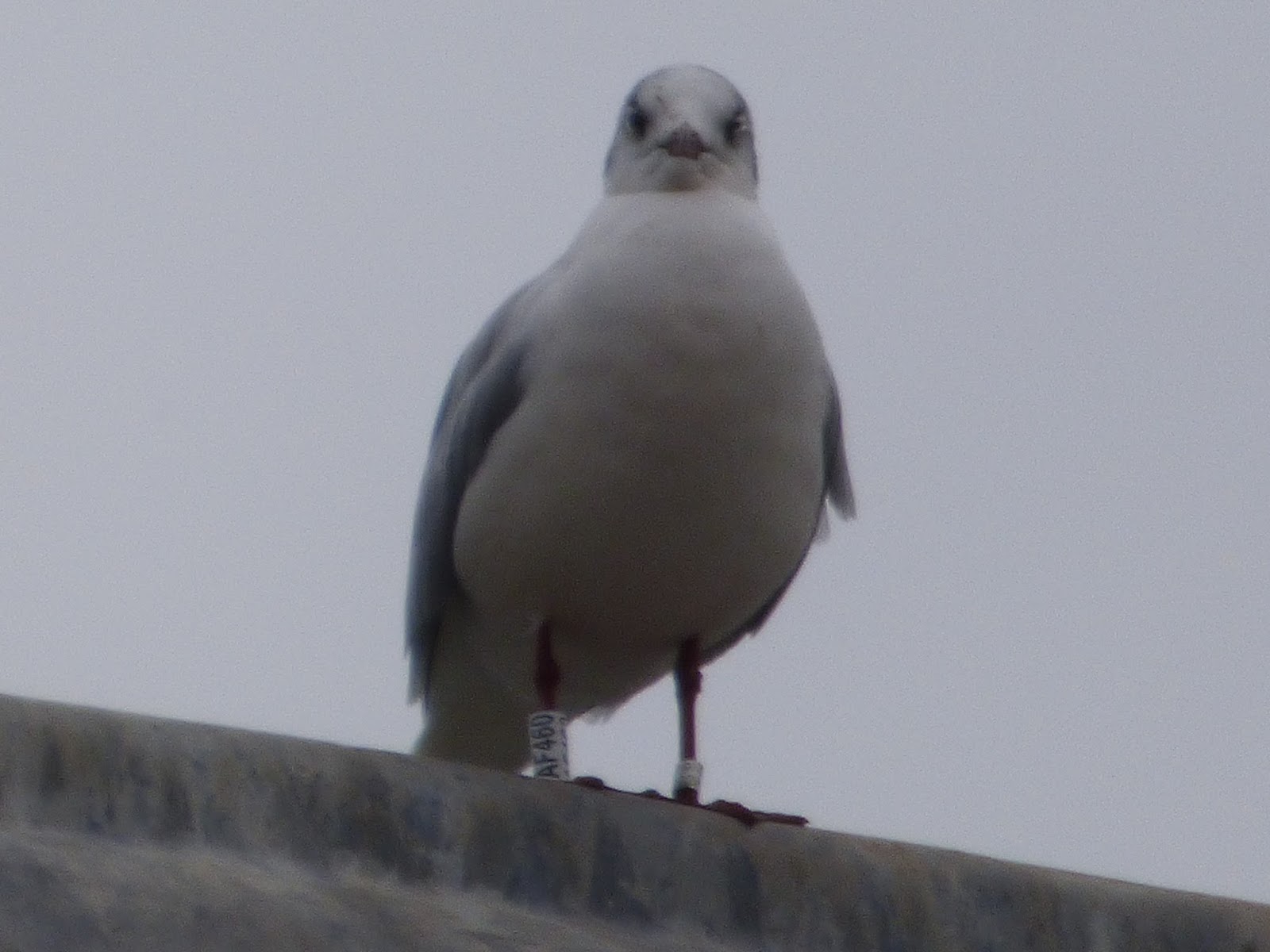
I've also received other recovery news over the last week for a couple of black-headed gulls. Firstly white AF460 that's been around Tredegar House for most of this winter was confirmed as a German bird. Summary of its history is as follows:
  • Ringed at Helgoland, Germany 12 March 2013
  • Observed at Pilling, Northampton, UK 12 January 2014
  • Observed at Helogland, Germany 02 July 2015.

Secondly the bird that showed well on the urban frontage of the River Usk, Newport early December 2015 was, as suspected, a Polish bird ringed as a pullus at Zachodniopomorskie on 8th June 2012.


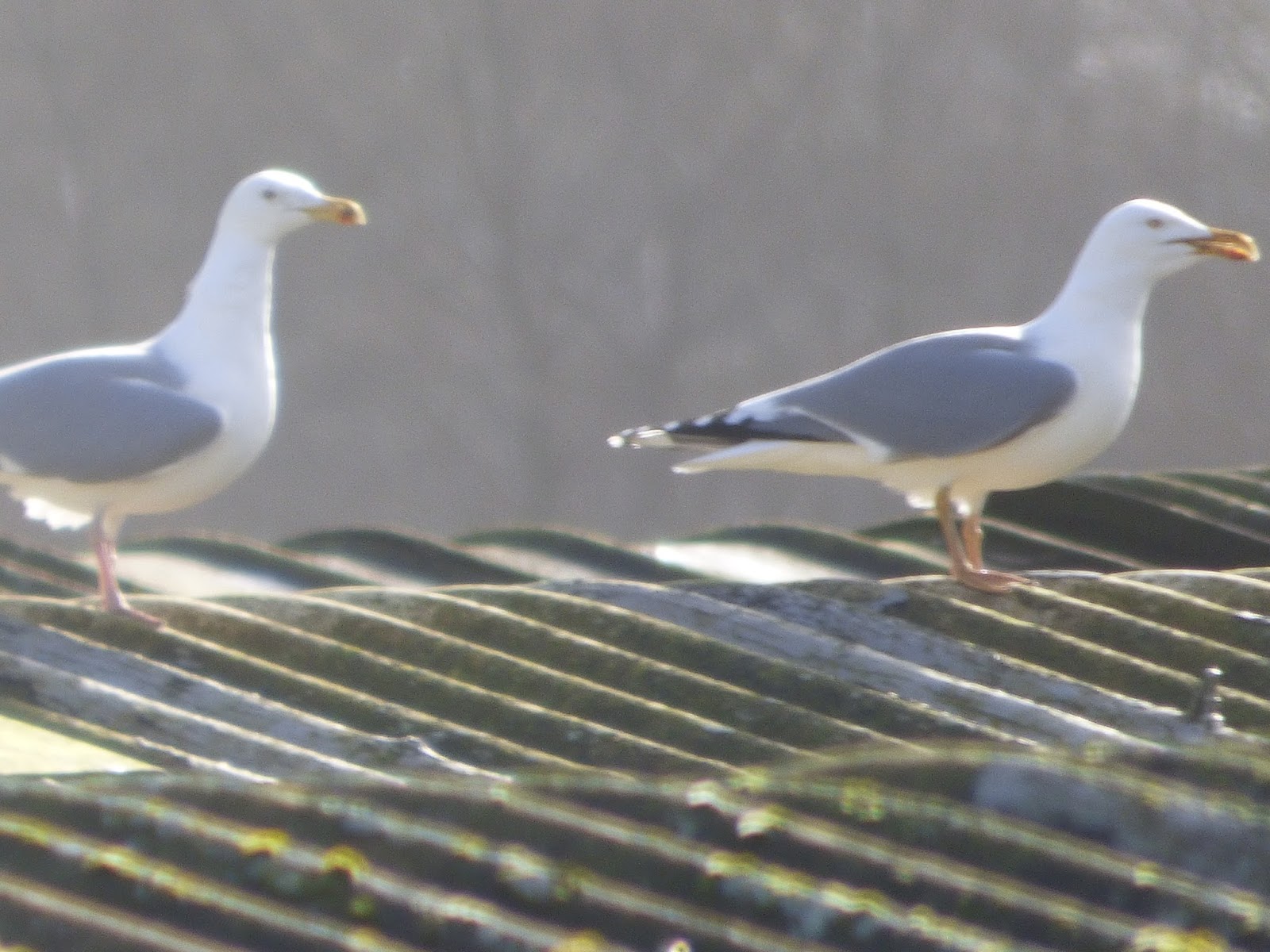
Finally I've not had a colour ringed lesser black- backed gull for a couple of years, so this one, white 7WH, on the rooftop around Asda, Brynmawr was a welcome change. Details coming some.


Monday, 8 February 2016

Brynmawr for gull watching


Whilst contemplating the destination of my usual Sunday morning excursion I had a recollection that around this time in previous years, gulls, mainly herring, were starting to congregate on their breeding site on the roof tops around Asda Brynmawr. And so it proved to be up to 60 birds were present on the undulating asbestos roofed redundant industrial building. My main objective was to check for colour ringed birds but on scanning the legs of herring gulls one stood out as not being pink.


This was my first yellow-legged gull in the north of the county and followed the Iceland gull found on the same building last February. The above photo illustrates some of the contrasting features between the yellow-legged and herring. Note the yellow legs, darker mantle, and bulkier head and neck form.


Saturday, 6 February 2016

Long stayer


I recently reported the sightings of three colour ringed black-headed gulls to their respective schemes - two Polish and one German. A prompt same day response from Rafal Sandecki regarding white TTW2 (see blog posting  17 October 2015 ) confirmed that it was ringed as a chick on 8th June 2015 in Culianian - Pomeranian Province on an island in Lake Kusowo, Poland.

Meanwhile the bird carrying white AF460 that's been frequenting the environs of Tredegar House since December last year can still be found often amongst the line of birds on the roof top of said building. A brief sighing of another bird with a colour ring covered in mud proved frustrating. 

Saturday, 23 January 2016

Once an Olympic sport


Live pigeon shooting was a popular nineteenth century past time, even featuring in the 1900 Paris Olympic games. This blood sport that consisted of live pigeons being released from a box trap in front of a 'gun' is no longer practiced in the UK but countries such as USA and Spain still entertain this questionable activity.

Historically live pigeon shooting was readily reported in local newspapers just like the scorecard of a village cricket match is nowadays. Below is an example of a newspaper report from the turn of nineteenth century detailing one such match.

'On Monday a pigeon shooting competition took place between the members of the Blaenavon Gun Club, at the new cricket grounds. The weather was very favourable, and a large number of persons assembled to witness the shooting. The first competition was for a sweep stakes of 10s each; five birds 21 yards rise and 61 yards boundary. Seventeen entered. Messrs. Wride and Brinkworth shot in their usual excellent style, and were deservedly applauded, each killing five birds. They divided the stakes between the shots. .John Wride, 111X1; John Brinkworth,11111; Evan Adams,11110; John Pullman, 10111; Willliam Cox, 11110; Henry C Steel, 11010; Thomas Davies 11010. For the sweepstakes of5s each ten entered, but as there were not sufficient birds left the stakes were  divided between Messrs, Wilson, Pulman, Orchard, Edmonds and Lewis, each having killed three birds. Hammon, of London, as usual, supplied the best blues. 

Given their bad press it can be easy to forget that feral pigeon is on the BOC British List and its felt the population and distribution of this species in Gwent is poorly understood. The large population of several hundred birds centred on Newport Castle featured a range of characteristic plumage varieties for those wishing to cut there teeth on pigeon recording.


Pied

Red

Checker

Blue

Black


Wednesday, 6 January 2016

Greyscale birds


This weeks collection of monochrome waterbirds from just two lunchtime visits to Cwmbran Boating Lake. Water rail, goosander, kingfisher, and tufted duck joined the more numerous Canada goose, black-headed gull, moorhen, coot and mallard.


Wednesday, 30 December 2015

Pottering


The beauty of time off from holding back the steady drip drip of environmental damage is having the space to ponder and potter. This week I made the short journey to scuff around a couple of the few remaining urban wildspaces of Blaenavon's inner town. 


St Peters churchyard is large. From its lime tree lined entrance it quickly opens up into a naturalists dream of unkemptedness. Grave stones, at more angles than a draughtman's set square, emerge from a threadbare, weather beaten, tangled mass of vegetation. A great spotted woodpecker called as it alighted in one of the several mature Scots pines followed quickly by the less aggressive call of a coal tit. I pushed my way through bramble and brittle stalks of rosebay willowherb over uncertain terrain that hid the remnants of graves and all the associated decaying stonework. A desire line that marked the lower boundary of this urban oasis and a road with a small cul-de-sac of houses was littered with discarded drinks cans. I knelt to examine an ornate headstone with the forms of wildflowers traced in the stonework and found some fresh dogs mess.


Leaving this place of the dead through a stand of Japanese knotweed and a newish wooden five-bar gate with a missing latch making its closing impossible, I left for the nearby Beeches house. A gully with a locally distinctive stonewall complete with a coping of slagstone led to this, another unmanaged urban green space.


Ty Mawr or The Beeches is a large former NHS nursing home and before that a base for industrialists to organise grouse shooting parties during the Victorian times. Now disused the house and grounds have declined significantly. Several mature beech trees carry the penknife carvings of teenage lovers from the 1960's  - an unrecognised cultural subject. A small common duckweed covered pond was populated with debris including a chair. I looked for a makeshift headstone that I remember seeing a number of years ago that marked the grave of a dog that was probably a shooters companion, but this could not be found. A fallen tree colonised with what appears to be oyster mushroom was compensation.


Saturday, 26 December 2015

Leaf-miners


It seems an obvious statement but the study of leaf-mines is a somewhat specialist area of the natural history spectrum. Nonetheless having checked the leaf-mines website this one on hart's tongue fern appears to have been 'dig' by the larvae of the fly Chromatomyia scolopendri and something of an unusual occurrence west of the Wye Valley. This one was found today on the edge of a limestone quarry near to Lasgarn Wood, Abersychan.


Tuesday, 15 December 2015

Baltic birds


I re-visited Newport Riverfront on Sunday morning in the hope the Lithuanian ringed black-headed gull that I was previously unable to read the full ring number, would still be present. Thankfully it was and a complete number was obtained. There was also a Belgium ringed bird on view. However, today during my lunch break I located a second Lithuanian bird, this time a first year bird, at Cwmbran Boating Lake. I will submit via the Lithuanian ringing scheme website (and BTO) and let you know in due course.


Sunday, 6 December 2015

The Lithuanian


Having promised to give a talk as part of next years Gwent Ornithological Society's indoor programme on 'Ring Reading: An Exercise in Citizen Science it was about time I started to gather some more information otherwise it could look a bit threadbare. Armed with  a small bag of assorted scarps from pizza crusts, bread and stale chips I made my way in pouring rain to Riverfront, Newport. A very obliging population of black-headed gulls were happy enough to line up single fine on the riverside railings but none carried any rings. Moving position some 200 yards or more south ward past the University of Wales building I seemed to attract a different crop of birds, soon attracting a Polish colour ringed adult black-headed gull. With food waste running low I was delighted to also locate a Lithuanian ring bird that was a bit flighty which was frustrating as I wasn't able to obtain a complete ring number before food ran out.


Leaving Riverfront to check out Tredegar House Lake I called in to ASDA for some of their own bread -33p a loaf. The good thing about this bread is that its baked stale, and if you doing believe me try some! A gathering of about 100 gulls made for a promising feel and soon it proved so with a German colour ringed bird among the scrum of squawking birds.


Sunday, 15 November 2015

Photography redefined


Taking an image of a great northern diver that was mid reservoir, in a howling gale and with a camera that doesn't perform the best at full magnification was something of a challenge. I think its called a record shot!

Wednesday, 11 November 2015

Putative intermedius


Among the many lesser black-backed gull (Larus fuscus graellsii) feeding on the edge of a falling tide along the Riverfront, Newport last weekend, was an individual that clearly sported a darker mantle. Although care needs to be taken when separating lesser black-backed gull subspecies it does suggest this bird is of the subspecies f.intermedius a species known to breed in Belgium and the Netherlands.


Related Posts Plugin for WordPress, Blogger...