Promoting observation, free range exploration, sense of place and citizen science through the field notes of a naturalist.


Friday, 29 July 2011

Blast furnace slag a substrate of some interest


There's a south facing bank around the back of the Gilchrist Thomas Industrial Estate in Blaeanvon that's entirely made up of blast furnace slag.  Although this bank is sparsely vegetation the plants that occur are worthy of mention. Field madder, carline thistle, wall pepper, and various cranesbill etc. etc. all jostle to for the nutrients required for growth in this hostile environment.


 Trying to keep my footing amongst the unstable slag I kicked up no end of micro moths many of which weren't worth pursuing due to there size and my unwillingness to fiddle with their genitalia in order to get an identification down to species level. All was not lost however as a couple were vaguely familiar enough to photograph and identify, namely Pyraustra despicata and Pyraustra purpuralis both widespread in the vice county.


Away from the blast furnace slag and on to a nearby road verge I came across this attractive moth called Marasmarcha lunaedactylaflying around its food plant is restharrow. A fly past black darter dragonfly and several marbled white rounded off the evening.

Monday, 18 July 2011

Essex skipper


Second visit to Llandegfedd Reservoir within a week - I'm really making my access tax work! The meadows around the north end are probably more interesting than the watery environment at the moment, and a stroll around this grassland habitat revealed a good number of marbled white, ringlet and gatekeeper, supplemented by both large and small skipper butterflies. 


The best find in amongst the myriad of lepidoptera was this little beauty, the Essex skipper. Widespread in southern and eastern England its been expanding its range into Wales with the first record from Gwent 2000.
Not an easy species to separate from its close relative the small skipper apart from the very distinctive black tips to its antennae.


Day flying moths were also evident including the silver y and the butterfly like shaded broad bar. Also photographed was the mint moth Pyrausta aurata.


The draw down zone is always good value for ground beetles, although a high water level restricts available search areas. Plentiful at the moment is the four spotted ground beetle (Bembidion quadrimaculata).

Bird wise, forget it, just one common sandpiper and a few sand martin. It's a measure of how birdwatchers have abandoned Llandegfedd when an elderly man who has paid his annual access tax of £8 only to walk around a nice environment, mentioned that I was the first birder he had come across this year!

Saturday, 16 July 2011

A:D's back!


This is A:D the colour ringed lesser black backed gull who frequents the Mendalglef Retail Park in Newport, relocated mid week on a family outing to Next. This bird along with many others is happy to spend its time loafing about on the tops of buildings and lamp posts but will swoop mercilessly in pursuit of a discarded Wotsit. Ringed as a nestling on the rooftops of Bristol on 20 June 2003.

Wednesday, 13 July 2011

Vintage JCB unearthed from wartime opencasting


The effort some people go to to fly tip is mind boggling. This kids plastic JCB was dumped along with assorted other stuff well off the beaten track at Canada Tips, Blaenavon and could only have been accessed by someone with a four wheel drive.


Late Sunday afternoon was a touch overcast which suppressed bird and invert activity. The odd mottled grasshopper and scarce blue tailed damselfly were noted and another patch of fir clubmoss. A patch of about 20 adders tongue fern found a couple of weeks ago proved difficult to relocate. The only significant bird was a very vocal peregrine that alighted several times on one of the many spoil tips.

Sunday, 10 July 2011

Tax paid


I reluctantly paid my 'take advantage of birders tax' for access to some Welsh Water sites. This years payment represents a modest 33% increase on last years cost thereby trumping (Donald) percentage rises in the Retail Price Index, petrol, council tax and even energy bills - I look forward to next years hike! As a case study in excluding/restricting/managing access to a fair chuck of prime habitat look no further than this as an example -so much for the well-being agenda! Its not hard to see how things would have panned out had the Government allowed the sell-off of Forestry Commission land in England - barred access and charges!


Rant over for the time being - although I will no-doubt revisit in due course- a female mute swan close into the dam wall was something of an unusual sight en-route to the north end. The meadows on the Island and towards the Bert Hamar hide are rich in invertebrates at the moment. Upwards of 30 marbled white with the odd red admiral, small copper and small skipper mingle with meadow brown.


Bird wise all the usual jokers were showing well, 150+ Canada goose, with the odd barnacle thrown in to keep us naturalists on our toes, good numbers of great crested grebe and cormorant. Reed warbler were vocal and a party of five bulky finches calling loudly as they took flight from the mature oak on the island are accredited as being hawfinch. Otherwise a single common sandpiper and a couple of 'hush hush don't mention' birds was the ornithological tally. 


Saturday, 9 July 2011

Cauliflower capers


My wife's usual forensic examination of all fresh vegetables for creepy crawlies turned up this little sap beetle that goes by the name of Gilschrochilus hortensis. Widespread in eastern England I assume it was transported with the cauliflower.

Sunday, 3 July 2011

Worn to ward off harm


According to my Observers Book of British Folklore there's a superstition that a dried frog worn in a bag round the neck of a child as a charm, will ward off harm. I'll be asking my son to wear this to school tomorrow - don't think he's going to co-operate some how!

Saturday, 2 July 2011

Goatsucker


A whole year or more has past since picking up the first unmistakable tones of a forestry clearing nightjar close to Blaenavon. With the breeding season starting to tail off I couldn't wait any longer to sample that dead giveaway 'purring' (see recent GOS web entry) or the opportunity would be lost for another year.

A 9.30 pm arrival was still just light enough to photograph a male whinchat and watch a bat disappear over the horizon. Sitting in car in a lay-by on a mountain road is a lonely existence and does illicit some looks from passing motorists - I was offered drugs and a sprig of lucky heather -  but by 10.15 pm with no sight or sound of nightjar and  the pull of a post mortem of Andy Murray's exit from Wimbledon on Radio Five Live I decided to wrap it up head home. But not before one final attempt at picking out the calling of this bird from the background hum of my tinnitus. Then at 10.18 pm there it was one bird, but not from the confines of the FC clearing but from the moorland edge. I left happy.

Wednesday, 29 June 2011

White letter day


A lunchtime visit to Pets at Home in Cwmbran offered more than just a bag Iams and some Bob Martins. On return to my car this white letter hairstreak alighted on the windscreen and was very obliging for some mugshots. 


Tuesday, 28 June 2011

Bryn bach tern around


Luke's posting of a couple of common tern as late as 3pm at Bryn Bach Park yesterday got me and my good wife travelling up the Heads of the Valleys road for an evening of mid summer relaxation in this popular Country Park ( what is a Country Park?).


If you don't mind having to constantly side step power walkers, joggers, fishermen, dog walkers and mobile phone users this park is a reasonable spot for accessible birding. Couldn't find any of the tern's though, so had to make do with photographing, once again, some of the commoner wildfowl.

It was the usual predictable mix of mute swan, Canada goose, tufted duck, great crested grebe blah, blah, blah! By the time we'd made it round the home straight of the lake circuit the skies has darkened and our pace had quickened discernibly having got caught up in the slip stream of a couple of JJB Sports account holding power walkers complete with iPods. Just past a notice board proudly displaying a collection of photographs of chubby fish caught by even chubbier middle aged fishermen there were a pair of great crested grebe feeding close in which had the effect of interrupting the rhythm of my accelerated pace. This was a mistake as the rain came and I got wet. - although made for some nice 'plip plop' raindrop photos.

Note: must get myself a pedometer, a head band and some lycra shorts at the weekend to ensure I don't get labelled a geek - too late I hear you say!

Saturday, 25 June 2011

Some birds of the lady type


22 Spot ladybird ( Psyllobora 22-punctata ) Abergavenny 19 June 2011

Harlequin ladybird ( Harmonia axyndis succinea ) Abergavenny 19 June 2011

Adonis ladybird (Adonia variegata) Varteg 31 May 2011


Water ladybird (Anisosticta 19-punctata) Garn Lakes Local Nature Reserve 25 May 2011

Such a popular feature of British summertime ladybirds are, compared to other coleoptera, well recorded that is until you examine distribution maps for vice county 35. I don't know what the problem is with biological recording in the county but not many recorders seem to bothered about submitting records.  Collecting biological data is so fundamentally important to informing and prioritising conservation action I urge everyone to submit records to the local records centre and/or the national recording schemes.

Sunday, 19 June 2011

Have flask will travel


I tried out my new Father's Day pressie of a retro style flask along the banks of the River Usk at Llanwenarth today. Its design took me back to the days when as a pre-adolescent I remember summer Sundays were all about John Arlott and John Player (cough!) Sunday League Cricket and not just another opportunity to go shopping. On the issue of smoking sponsorship etc. I vividly recall my sense of shock when as a young Yorkshire fan I witnessed aghast as Phil Sharpe ace batsman and slip fielder was interviewed on TV during a Roses match smoking heavily!


Its always a pleasure walk along the River Usk. A colony of between 40 and 50 sand martin were busily feeding young within an eroded bank. A couple of common sandpiper were vocal along with whitethroat, garden warbler and a distant cuckoo. Two curlew were active in adjacent field and on one occasion birds were seen to mob a corvid, suggesting they have young.


I first became aware of the river shingle spider (Arctosa cinera) through the pages of Colin Titcombe's books on the Wildlife of Gwent. It is a large furry spider thats seem reasonably common on shingle banks - certainly not one for the phobic 


Amongst the plethora of ground beetles on offer was this little gem. Bracteon litorale is an Nationally Scarce (B) species only found on sand banks on the margins of running water.

Thursday, 16 June 2011

Speckled Longhorn Beetle


Pick of the bunch yesterday evening from Lasgarn Wood was this speckled longhorn beetle (Pachytodes cerambyciformis). Methinks I've recorded this one before but certainly not for a while. NBN tells me that Wales is very much a stronghold for this species and for Gwent most records come from the Wye Valley.

Tuesday, 14 June 2011

A sleepy Summers day


Made the effort to get down to the big metropolis this morning in the hope the spoonbill would still be around - and it wasn't! Thats it!


Tyre bay


Complete with a fresh bi-annual haircut and some leave and I was off to sample the natural heritage of the Varteg.  First stop was a well known flytippers mountain track. Here I found various black bags spilling baby clothes, a number of asbestos sheets, several piles of conifer cuttings and a good number of tyres.


From this dismal setting I climbed the hillside to the flanks Mynydd varteg fawr. Although Sundays deluge had departed it was still a tad blustery thereby depressing bird activity to a disappointing level. It wasn't until I reached a spot that offered some shelter was I able to pick up wheatear, stonechat and a number of reed bunting.


Like most of the coalfield the landscape here is pock marked with little features that hint at a former use. Tracks, stonewalling, small quarries with piles of excavated stone and channels now full of water complete with margins of cotton grass and the odd broad bodied chaser.


For a mid June day its was nothing to shout home about. A round trip of about three hours only small numbers of birds the most notable was six pair of reed bunting and four pair of stonechat.

Monday, 13 June 2011

Pay and display


Pay and Display car parks have a debilitating affect on me. I'm sometimes struck by a temporary paralysis that attacks my hands when tightly clenched around the coinage necessary to by a ticket. Releasing the money is painful, a finger by finger process exposing the money from within my sweaty palms.


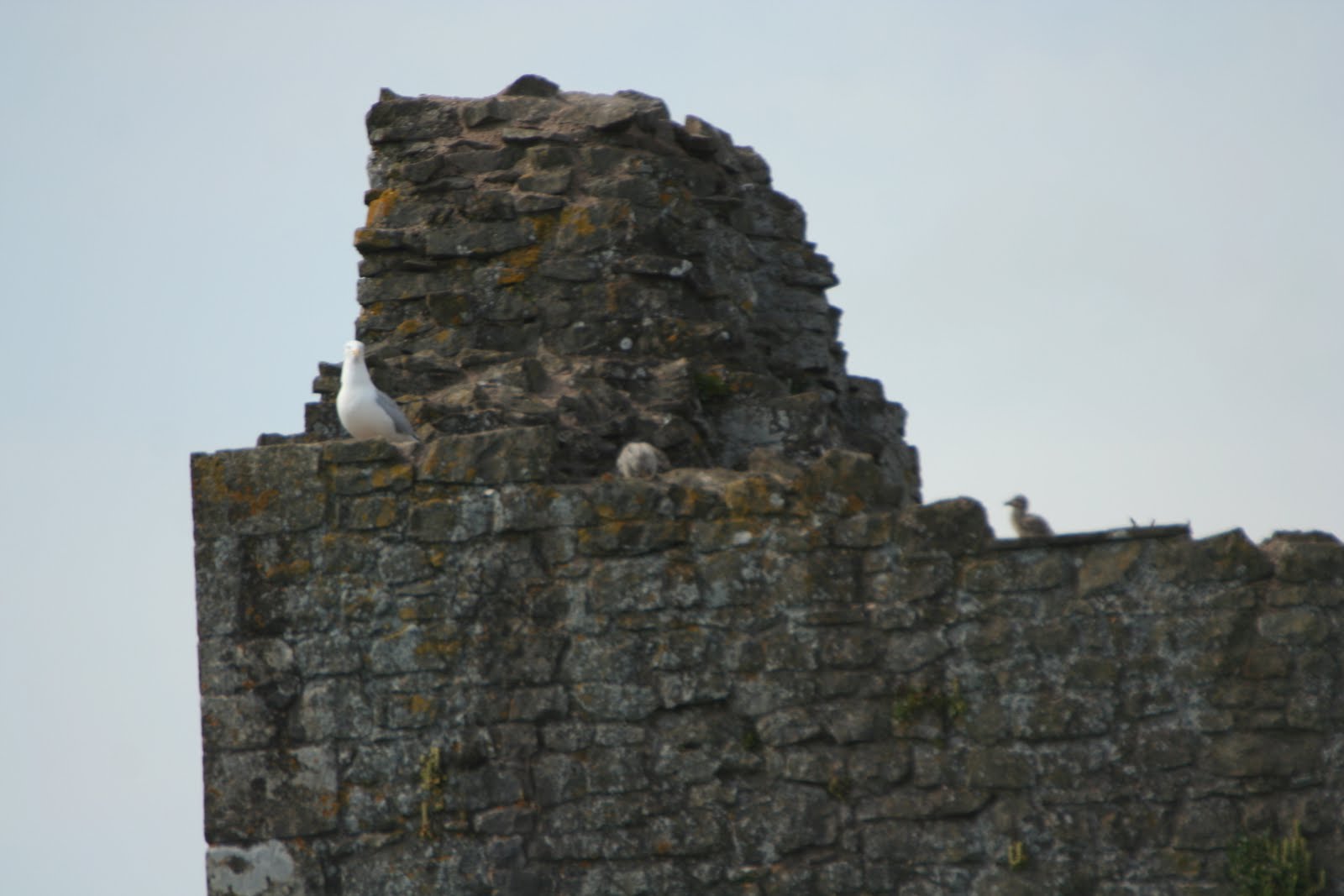
Paying for a car parking ticket is much more acceptable however if there's a pleasant view complete with some living things. From the Pay and Display car park in Chepstow is a good view of the Castle and with it about five pair of breeding herring gull with young.


Sunday, 12 June 2011

Fence posts: an appreciation


Ask any students studying an NVQ in Countryside Management and they'll confirm that sticking up a fence is a skill as fundamental to land managers as tractor driving, game bird husbandry, the setting of snares and raptor persecution. So this cyber notebook entry takes a look at the contribution this most basic of boundary feature offers to an upland landscape where natural vantage points are generally thin on the ground.


The disused Waunafon bog railway cutting is flanked by an  assortment of wooden and concrete posts linking a dogs breakfast of wire fencing and cheap and cheerful subsistence farming repairs. Chicken and barbed wire, rusty and new is patched with the odd pallet and corrugated sheet,  joining posts very few of which remain in their original upright position. The now decaying timber posts are attractively well adorned with various lichens and bryopyhtes with some supporting the remains of the odd raptor pellet but many with a crusty top of passerine guano. And once, given the extent to which this landscape was managed for red grouse, will have no doubt been ideal for an odd gin trap or two.


As you would expect at this time of year this mornings 'post posers'  were busily flitting between post and wire feeding fledglings and ticking off a naturalist who dared venture into their patch. But no surprises amongst the assemblage which  included many meadow pipit, the odd male blackbird, two separate family parties of stonechat, a reed bunting and a couple of swallow. However the most numerous bird to take advantage of the posts was a post (no pun intended) breeding flock of about 200 starling.


I like these features as there's something quaint and 'arty' about a gnarled and decaying timber post. It adds character and distinctiveness to a landscape that was obviously much more managed in previous generations than today. These undervalued landscape features often jostle for attention with remnant drystone walls and lost farmsteads.

In this landscape the meadows created by the erection of said post and wire are almost without exclusion semi-improved, rich in herbage and invertebrates. Several species of orchid, adders tongue fern, moonwort and other measures of quality grassland attract damselflies, moths, bees, butterflies etc. etc.


The most surprising find however was a patch of ten or more bee orchid north of Garn Lakes Local Nature Reserve. It wasn't too long ago that this botanical attractant was championed as a species restricted to middle class Conservative Monmouthshire, only occurring in Wye Valley areas. Thankfully, it's now crossed the floor to embrace the promised land of diluted socialism and is frequently encountered in the 'yucky' western coalfield of Gwent.

Related Posts Plugin for WordPress, Blogger...