Promoting observation, free range exploration, sense of place and citizen science through the field notes of a naturalist.


Sunday, 25 October 2020

We'll keep a welcome in the hillsides


Before the hounds are set on me by my farmer friends I must say that I do have first hand experience of the damage stray dogs can do to livestock. So, I would strongly contest any notion that I'm a townie with a Beatrix Potter image of the countryside. I remember vividly witnessing the attempts of passers by to extract a bull terrier type dog locked on to the face of a sheep. The animal was eventually released but not before it had inflected some serious wounds to the poor sheep. 

The old pit road from Waun afon bog along the lower slopes of the Coity towards the Varteg has become a very popular public thoroughfare. My walk along the very same tarmacadam route last weekend was punctuated by cyclists, runners, family walkers and off road bikes. So it's clear that local famers have had problems with some dog owners who have little respect for those eking out a living from this landscape. Even so, the spray painted message that loose dogs will be shot equally demonstrates an in tolerance to the public who also have the right to use this landscape legally. Surely not all loose dogs worry sheep so it cannot be fair or right to tar all dogs and their owners with the same brush. Its only those animals that have an unhealthy interest in sheep that should run the risk of being shot. 


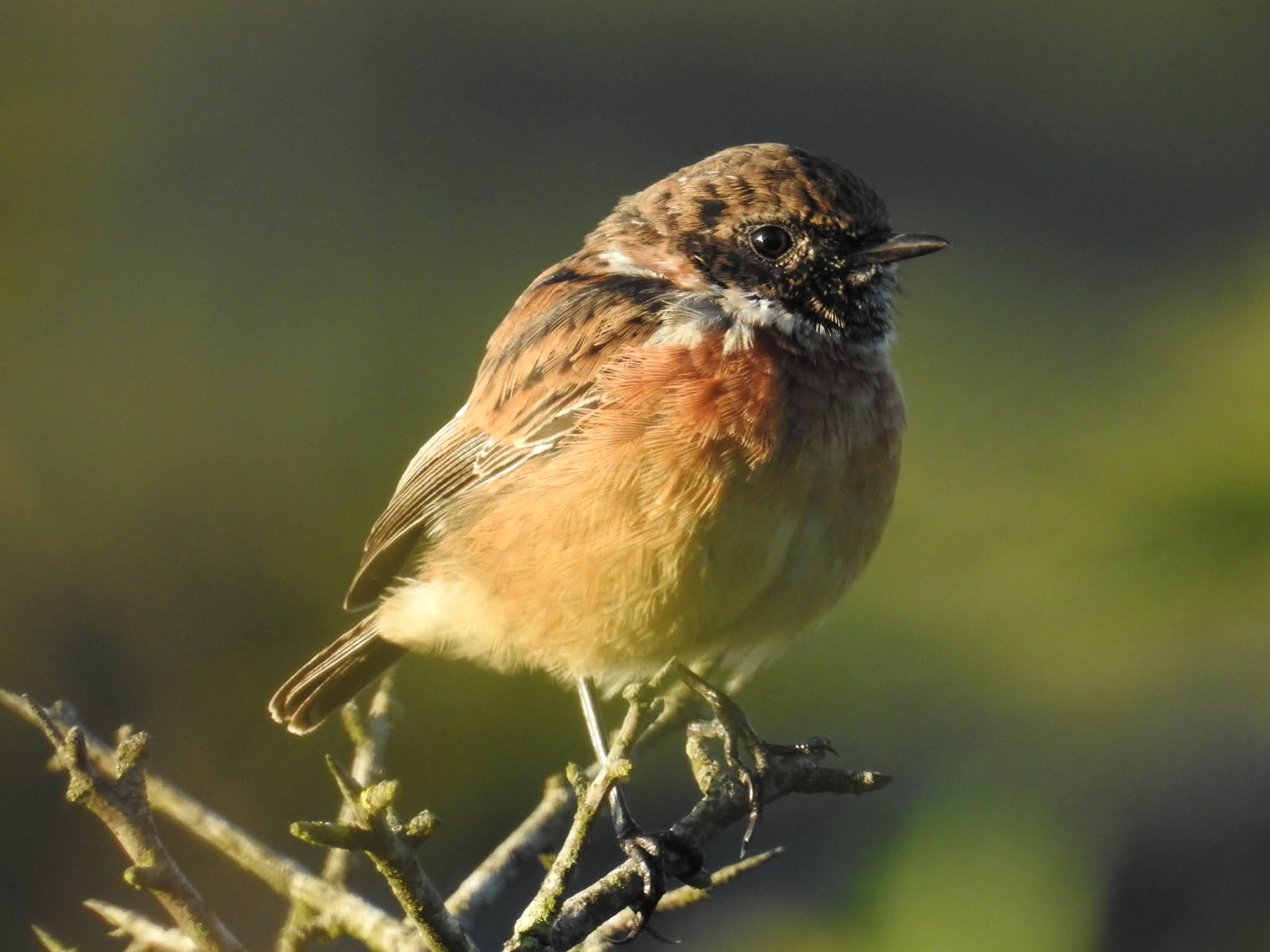
My excursion from Garn Lakes Local Nature Reserve through the ffridd habitat and enclosed grassland of the lower slopes of the Coity was notably for the variety of winter thrushes that were feeding on  rowan and hawthorn berries. Small numbers of blackbird, song thrush were joined by redwing and fieldfare. A pair of stonechat were also present.

Where the natural upland to lowland flow of water has been interrupted by mine workings and farm tracks small pools occur. Here, typical wetland plants including bog pondweed and round-leaved crowfoot are still showing well.


In the distance I could see the Mile Pond a linear waterbody constructed by our industrial forefathers. Deploying my new Nikon Coolpix I picked out a single little grebe and 11 wigeon. Wandering around the disused Coity mine I found a large patch of stump puffball. It was the large landslide on bund that hides the mine from the nearby town, Blaenavon, that made the news during the heavy rain of last February. As I made my way around the mine there was further evidence of the impact of this weather through several substantial rock falls.




Tuesday, 1 September 2020

A nip in the August air


A nip in the late August air had me searching my pockets for a pair of gloves. The exposed landscape of the Blaenavon hinterlands can be unforgiving at the best of times but was a little unexpected in the run up to the Bank Holiday. The pockets of a naturalist's coat can be busy, mine is no different; an unsharpened pencil, a few small mollusc shells, some dried vegetation in a pot that may take a bit of explaining in front of law enforcement and a fossil, the only thing missing was a copy of I-Spy book of birds.

My oft-trodden path to the wider envions of Garn yr erw was made a little easier by the actions of footpath clearance, but once through the metal field gate it was back to the rugged acid grassland dominated features of that randomly disposed of coal spoil. The interface between enclosed grassland and the wider unrestricted access of the uplands is often just a post and wire fence or dry stone wall. At this time of year these vantage points can be rich pickings for viewing the autumn movements of ffridd-land birds. Today was no exception. The familiar metallic scolding call of a stonechat was soon detected and a reed bunting briefly showed.

It was too early in the day for dragonflies and damselflies but the former industrial ponds around Garn yr erw were nevertheless very picturesque. A single tufted duck took flight in a rather laboured way. A couple of wheatear moved around the remains of a drystone wall and five red grouse were spooked from nearby heather.

I made my way to another water body, part of the hidden nature of the Blaenavon landscape. But, maybe not so hidden as I thought as yet another painted stone marked the presence of visitors during the Covid-19 lockdown. Where the wet heath bleeds into this large expansion of standing water there is a thriving population of flowering round-leaved sundew.


Back via the now disused farmstead of Tyr Abraham Harry a few solitary trees caught my eye. Most were straggly hawthorn battered and shaped by their exposed location, but one was different. A crab apple tree complete with lichens was the most significant. These few trees were situated on a bank that is clearly a remnant field boundary. 


Friday, 7 August 2020

A smiley face at The Punchbowl


At the foot of The Blorenge is the Woodlands Trust's Punchbowl reserve, comprising mainly, as you would expect, of woodland along with a pleasing lake. This a popular visitor attraction for walking, picnicking, camping and fishing, although the latter two are banned.

The motivation for this visit was mainly dragonflies and damselflies but unfortunately the weather was on the indifferent side with cloud and showers. Nevertheless a few breaks in the cloud cover produced enough warmth to generate some damselfly activity. Blue tailed and emerald were abundant with a few scarce blue-tailed thrown in for good measure. There were no dragonflies on the wing. Some stone turning produced a good population of great diving beetle.

Botanically the lake is notable for its wide margins of the non-native aquatic plant New Zealand pygmyweed. From within the beds of pygmyweed, shoreweed, marsh pennywort and lesser spearwort could be found. A large stand of bottle sedge is on the lakes western shore.

The return route is steep and strenuous, but flanked by ancient and veteran beech and oak trees. Several family parties of stonechat were present where gorse dominated sheep pasture blends with bracken slopes. A boundary apple tree was starting to produce fruit.

Leaving the reserve through a field gate there was a good population marsh cudweed growing from the bare soil of well worn wheel ruts. Beyond small area where most visitor park their cars. Here I noticed a rather innocuous looking pebble, but on its reverse was a brightly painted smiley face.  


Sunday, 26 July 2020

On the margins of a SSSI


Who drew the boundary around the Blorenge Site of Special Scientific Interest (SSSI)? Come on own up! Was it a task of a fresh faced, unsupervised, Youth Training Scheme operative with map and felt marker or was an informed judgement driven by Ratcliffe's criteria. Either way I scratch my head as to why the varied mosiac of regenerating coal tips of dwarf shrub heath and associated bog pools that occur on its western margins were excluded. In fairness this SSSI was designated in the 1970s at a time when coal was still king and the tips in question would not have had the vegetational development as today. Even so there was clearly a lack of vision in the drawing of this boundary. My view, and one that is only based on anecdote, is that unconscious bias played its part. There couldn't possibly be any nature conservation value in the spoils of industrial activity, lets play a straight bat and draw the boundary around land that's got none of them bloody horrible coal tips! Better to focus on the 'naturalness' of keepered moorland that was fashioned by the local iron masters for grouse and wader shooting.

With that off my chest, I made a couple of mid month visits to this second class habitat, one that's done its revision and is doing its best to be accepted by the SSSI, just like a working class student hoping to attend Oxbridge.  On the well worn footways that are outside of the SSSI but that eventually take you into the site are masses of flowering wild thyme. On this low growing herb the pollinators were plentiful, including honey bee, heath and bilberry bumblebees. Here too some of the thyme displayed the characteristic fluffiness of thyme gall mite Aceria thomasi.  Towards a part drained industrial reservoir a number of butterflies were on the wing. Notably, dark green fritillary, small pearl bordered fritillary, marbled white, small heath and the first grayling of the summer. At the waterbody good numbers of scarce blue tailed damselfly and emerald damselfly were present. On a patch of bare ground I found a dying horsefly that turned out to be the first county record for the golden horsefly, a specialist of upland bog pools.

Onto the nearby Balls Pond. This too is a product of Blaenavon's industrial heritage but still contains a substantial body of open water. Here some of the larger dragonflies were on the wing, including black-tailed skimmer and four spot chaser


Saturday, 18 July 2020

Border country


From Garn lakes Local Nature Reserve follow the boarded cycleway northwards towards the border between the county boroughs of Torfaen and Blaenau Gwent. The habitat here is much the same as that of the rest of the Blaenavon World Heritage Site, post industrial but with impressive views of Waunavon Bog.

If you want to see nature, sticking to the well worn pathways and tracks has its limitations. My modus operandi is to drift into habitats and features that others may resist. A depression in the ground, a pond, a groups of trees are all far game. On this visit my rambles and scrambles through rank vegetation got me to a marshy depression in the ground. Along with an extensive stand of marsh horsetail I stumbled over one hundred adder's tongue fern. Having only found a few individual plants in this landscape before, this is by far the largest population. Further on, the creeping willow I found last year is still thriving.

At the top of the cycleway is an area of re-profiled coal spoil that was once a fly tipping hotspot. It was no surprise therefoe to find some well established garden plant refugees, including lady's mantle and trailing bellflower. Off the cycleway again to explore a bank of re-vegetating spoil and I a few plants of the hare's foot clover. This plant is on the rare plant register for the vice county of Monmouthshire,


Wednesday, 15 July 2020

Orthoptera recording


Some years ago I answered a call from the UK orthoptera recorder for volunteers to fill vacant county recorder positions. The vice county of Monmouthshire happened be without a recorder so I stepped up to the breach and put my name forward. I started with enthusiasm visiting sites across the vice county building my knowledge and developing a picture of local grasshoppers and crickets with the aspiration of organising and preparing a provisional county atlas. It eventually became apparent that taking on this task, whilst holding down a demanding job along with family obligations, was a challenge too far. My recording of orthoptera has therefore tapered off. I am still the county recorder and I still record where possible, so when a grassland site in Hollybush, Cwmbran showed promise I visited to see what was on offer.

First up was the now ubiquitous long-winged conehead, This a now one of the most widespread and expanding crickets in Monmouthshire. Another recent coloniser that was present at this site was Roesel's bush cricket this species is also expanding its range very quickly. 


Saturday, 4 July 2020

A week of Odonata


A week off work and at last some quality time to out in the marvelous post-industrial landscape of the Blaenavon World Heritage Site. I've expressed my views about how important this area is as a wetland landscape previously, but as I've said its a landscape largely off the radar of most naturalists (but not all) and certainly doesn't have the same nature conservation profile as the Gwent Levels or the Wye Valley.

When out recording dragonflies and damselflies it helps to have some warm weather and for my visits this was certainly the case. My first excursion took me to the Canada Tips area, where a female four-spotted chaser and a male broad-bodied chaser obliged for photographs. Also recorded on this visit was a large red damselfly, a few blue-tailed damselfly and many common blue damselfly.

The following afternoon I took in the ponds of Garn-yr-erw and a few of the smaller ones at the top of Garn Lakes Local Nature Reserve. One particular pond supporting masses of flowering common cotton grass took up most of my time. Its a site off the beaten track and one that is only shared by motorbikers. Here several emperor dragonflies engaged in aerial sparring, others where busy ovipositioning. To my surprise I found a male black-tailed skimmer. This is not a species I've encountered in the uplands as its usually replaced by the keeled skimmer but there is some suggestion the range of this species is expanding.

At Garn Lakes there were too many people, pushing my social anxiety through its threshold, so I only took in a couple of smaller ponds on the margins. Here a number scarce blue-tailed damselfly laboured through the emerging common spike rush. Here too was a common darter, a common dragonfly but one I tend to associate as a late summer species.

My final visit was conducted in less favourable conditions. It was cold, windy with unpleasant showers, not ideal for odonata. Needless to say there were few about. That said, when scrambling down a bank to shelter from a sharp shower I found, by chance, a golden-ringed dragonfly perched motionless from the woody stem of a bilberry bush.


Tuesday, 23 June 2020

Once there were Lapwing


Waun Hoscyn is an expansive area of re-vegetating coal spoil between Varteg and Blaenavon. Its a site I once found breeding lapwing and snipe, nowadays lapwing are no more. During the hard times of the infamous miners strike I also remember seeing people harvesting surface coal from Waun Hoscoyn. Today, its only populated by the odd dog walker and golfer, pitching and putting in an area of sheep grazed acid grassland.

The habitat of coal spoil is a mosaic of bare ground, dwarf shrub heath, dry and marshy grassland. Its the marshy grassland that I find the most interesting - it often holds the highest plant diversity. Last Saturday morning started cold and overcasting but this didn't stop the skylark from singing. Although whinchat numbers seem to be in decline by contrast stonechat are doing really well. On this walk I recorded at least two pair. In an area of marshy grassland there was a meandering water course, dominated by common cotton grass on its margins. Here there was a good population of southern marsh orchid with a few scattered heath spotted orchid for good measure. In another flush I found a very small example of royal fern. This fern is listed on the rare plant register of Monmouthshire.


Sunday, 21 June 2020

Ferns and clubmosses


Now don't laugh, but I've developed a bit of a liking for ferns and clubmosses partly because there are very few other local naturalists with the same niche interest. Last weekend I did my annual count of moonwort on Coity Tip, Blaenavon. In previous years numbers were well into the hundreds, unfortunately on this occasion I could only see around nine, but the weather on this visit was not conducive to botanising, so this may be an underestimate.

By the afternoon things on the weather front had improved so I headed for Canada Tips to check on the most southerly population of alpine clubmoss in Wales. With an apparent increase in scrambler bike activity around the tips I was relieved to find the plant safe and well, along with a small number of fir clubmoss. I've not yet made contact with adders tongue fern this year but hope to do so within the next few weeks. I am also in the process of confirming a record of royal fern I found recently in an acidic flush between Varteg and Blaenavon. This fern is only known from three or four localities in the vice county of Monmouhshire.


Saturday, 20 June 2020

Between the dead and the buried


Lockdown has forced me into fragments of semi-natural habitat that I'd always promised myself I would explore but never managed to get around to it. At the Blaenavon end of Cwmavon Corridor Local Nature Reserve is a cemetery. This is a large burial ground comprising of an old area with an interesting diversity of grave stones, contrasting with a new and active part with its equi-spaced rows of uniform headstones. In between there is a watercourse, mature trees and acid grassland. 

It was refreshing to see balanced and informed approach to the management of this site. Yes there were the traditionally managed areas of cut grass, but in other parts the grass and wildflowers were left to thrive. Here I found large skipper and small heath butterflies along with the a burnet companion moth. A tree pipit moved from headstone to headstone suggesting the presence of an active nest nearby.

The older part of the cemetery was awash with wildflowers blending with more naturalised species that over time have spilled from the confines of the well kept graves into the adjoining vegetation. Oxeye daisy stood out along with lesser hawkbit around the path margins. Fox and cubs was numerous and ferns grew unchecked from many graves. All in all a very rich and delightful cemetery that's worth another visit.


Related Posts Plugin for WordPress, Blogger...