Promoting observation, free range exploration, sense of place and citizen science through the field notes of a naturalist.


Tuesday, 23 June 2020

Once there were Lapwing


Waun Hoscyn is an expansive area of re-vegetating coal spoil between Varteg and Blaenavon. Its a site I once found breeding lapwing and snipe, nowadays lapwing are no more. During the hard times of the infamous miners strike I also remember seeing people harvesting surface coal from Waun Hoscoyn. Today, its only populated by the odd dog walker and golfer, pitching and putting in an area of sheep grazed acid grassland.

The habitat of coal spoil is a mosaic of bare ground, dwarf shrub heath, dry and marshy grassland. Its the marshy grassland that I find the most interesting - it often holds the highest plant diversity. Last Saturday morning started cold and overcasting but this didn't stop the skylark from singing. Although whinchat numbers seem to be in decline by contrast stonechat are doing really well. On this walk I recorded at least two pair. In an area of marshy grassland there was a meandering water course, dominated by common cotton grass on its margins. Here there was a good population of southern marsh orchid with a few scattered heath spotted orchid for good measure. In another flush I found a very small example of royal fern. This fern is listed on the rare plant register of Monmouthshire.


Sunday, 21 June 2020

Ferns and clubmosses


Now don't laugh, but I've developed a bit of a liking for ferns and clubmosses partly because there are very few other local naturalists with the same niche interest. Last weekend I did my annual count of moonwort on Coity Tip, Blaenavon. In previous years numbers were well into the hundreds, unfortunately on this occasion I could only see around nine, but the weather on this visit was not conducive to botanising, so this may be an underestimate.

By the afternoon things on the weather front had improved so I headed for Canada Tips to check on the most southerly population of alpine clubmoss in Wales. With an apparent increase in scrambler bike activity around the tips I was relieved to find the plant safe and well, along with a small number of fir clubmoss. I've not yet made contact with adders tongue fern this year but hope to do so within the next few weeks. I am also in the process of confirming a record of royal fern I found recently in an acidic flush between Varteg and Blaenavon. This fern is only known from three or four localities in the vice county of Monmouhshire.


Saturday, 20 June 2020

Between the dead and the buried


Lockdown has forced me into fragments of semi-natural habitat that I'd always promised myself I would explore but never managed to get around to it. At the Blaenavon end of Cwmavon Corridor Local Nature Reserve is a cemetery. This is a large burial ground comprising of an old area with an interesting diversity of grave stones, contrasting with a new and active part with its equi-spaced rows of uniform headstones. In between there is a watercourse, mature trees and acid grassland. 

It was refreshing to see balanced and informed approach to the management of this site. Yes there were the traditionally managed areas of cut grass, but in other parts the grass and wildflowers were left to thrive. Here I found large skipper and small heath butterflies along with the a burnet companion moth. A tree pipit moved from headstone to headstone suggesting the presence of an active nest nearby.

The older part of the cemetery was awash with wildflowers blending with more naturalised species that over time have spilled from the confines of the well kept graves into the adjoining vegetation. Oxeye daisy stood out along with lesser hawkbit around the path margins. Fox and cubs was numerous and ferns grew unchecked from many graves. All in all a very rich and delightful cemetery that's worth another visit.


Sunday, 14 June 2020

Pontypool's pavement plants


Urban Ferns

Not weeds but spontaneous urban plants. These plants show incredible resilience in the face of societies constant effort to eradicate. A walk around any urban setting will reveal a diversity forgotten by many championed by few. I am one of those champions. It's impossible to visit a town centre without casting my eye over those neglected corners looking for nature that softens the cold, sterile and bland grey built environment.

Pontypool Town Centre is a useful case study, and during lockdown it can be examined more closely without the prying eyes of curious shoppers. Ferns are widespread. At the base of the entrance pillars to HSBC are at least three species including hart's tongue fern, wall rue and maidenhair spleenwort. Elsewhere, the rambling nature of hairy tare is a constant of unmanaged fragments of planting beds. These bits of neglected horticulture can be rich pickings for urban naturalists. One such area sported common bistort, hedge woundwort and wall lettuce. A redundant public realm planter in front of the Civic Centre contained a mass of smooth tare. Across the road from the Council offices is the Italian Gardens complete with a moss covered water soaked ornamental fountain. Between the stonework I could see the ever present hart's tongue fern, but adjacent to this bog standard specimen was the variant undulatum with the wavy outer edge to its fronds. Was this purposefully planted or has it colonised naturally?

The attractive yellow of the wall-flower has taken hold around some of the buildings at the Clarence end of Pontypool as well as the former Lloyds bank and its adjoining building. Here too red valerian is is becoming increasingly plentiful. Where the road side verges have escaped the actions of grass cutting Oxford ragwort can be found along with an odd patch of kidney vetch. A patch of biting stonecrop completed a most enjoyable botanical ramble around Pontypool Town Centre.


Hairy Tare

Common Bistort

Harts Tongue Fern undulatum

Hedge Woundwort

Wall Lettuce

Oxford Ragwort

Red Valerian

Smooth Tare

Naturalised Wall-flower

Biting Stonecrop


Friday, 12 June 2020

Cwmavon Corridor Local Nature Reserve


Within walking distance, albeit a little further than what I've recently been used to, is Cwmavon Corridor Local Nature Reserve. A nature reserve designated by Torfaen County Borough Council that is centred on a cyclepath but flanked by ancient woodland complete with commanding views of the upper Afon Llwyd valley.

Taking a steep and winding footpath off Cwmavon Road I emerged into a woodland fresh with a recent burst of vegetation. A great spotted woodpecker called frequently as I plodded along a well trodden path, in the distance I could hear a wood warbler singing. As the path became less accessible I turned only to be confronted by a barking and growling Dobermann dog, to my relief its owner eventually emerged, somewhat surprised to see me.

After that fright I left the wood emerging onto the cyclepath that is the nature reserve. The morning was sunny and warm and the cyclists were out in force. As I walked north I was surprised to find a stand of common bistort a plant I've only found in a urban setting. Further on, the cyclepath margins were well populated with yellow pimpernel a species I often find on woodland rides. 

Passing a little flowering group of Welsh poppy I scrambled down a bank back into the woodland to rejoin the footpath that I had the previous encounter with a dog. As I approached a stile to my surprise a homemade sign came into view. No entry Covid-19 it said. The bare faced cheek of whoever thought this would stop walkers legally using this footpath. I ignored it and carried on.


Saturday, 6 June 2020

Limestone spoil


One of the nice things about living on the edge of the south Wales coalfield is that I'm never too far away from the geological margin of carboniferous limestone that encircles the coal measures. For a person who craves landscape variation this gives me the opportunity to jump in and out of differing plant communities like a game of school yard hopscotch.

Now I love a perturbation. The havoc wrecked by our industrial forefathers has left a legacy, not of dereliction as many decision makers will have us believe, but one of intrigue and variety that nature is reclaiming with characteristic enthusiasm. 

Climbing through Company's Wood a disused tram line takes you directly to a small limestone quarry complete with its moderately sized spoil heaps - nothing like the jumbo coal tips that litter the nearby Blaenavon landscape. On this visit I diverted mid way to take a track the produced by recent forestry operations. Some log turning produced a bit of a surprise in the form of a great crested newt. All the more surprising that the nearest know water-body is some distance away. Where the forestry ends the ancient woodland starts complete with its impressive beech trees. 

At the end of the track it rejoins the tram line at the foot of several limestone spoil tips. Gripping the some of the self seeded ash trees I am still just about able to scramble up these tips, but for how much longer I wonder? At the summit I was able view the quarry and its spoil but know largely full of hawthorn and blackthorn scrub along with some larch that was planted but a previous misguided tree planting scheme. Where the scrub thins the vegetation is of fine grasses, wildflowers and bare ground. Here several dingy skipper were on the wing, alighting on the warming bare ground. But, due the rapid nature of scrub development, the long term future of grassland butterflies such the dingy skipper is uncertain. For me the removal of scrub and conversion back to limestone grassland is a conservation project in waiting. 


Sunday, 24 May 2020

Appreciating the local


Out appreciating my local patch again, this time on the lower fringes of Mynydd Garn-wen. Following the hedgerow lined thoroughfare of Lasgarn Lane brings you to Mynydd Garn-wen with its whitewashed trig point and panoramic view of agricultural Monmouthshire to the east and the Severn estuary to the south. Whilst the trig point with its undeniably impressive vista was the destination of other local exercisers I took a route that followed a dry-stone wall northwards.

Upland boundary features are a magnet for some birds. That combination of wall, fence post, barbed wire and the occasional tree, frequently attract the likes of wheatear, stonechat,and meadow pipit. The shelter from the mountain wind that a good field boundary provides benefits the one of the few upland butterflies. Up to four green hairsteak were noted fluttering around the banks of dead bracken that grade into the tight sward of the sheep grazed acid grassland.


Sunday, 17 May 2020

Chocolate box quality


One of the benefits of this Covid-19 lockdown is that restricted movement shoe horns you back into your local environment. Gone are the drives to other places, in are the walks to familiar places.That said, I'm beginning to realise those familiar local places may not so familiar after all.

As you can tell from recent posts I've been taking a 10 minute walk to the woodland I can see from my home, but on this occasion I pushed on beyond its leafy glades with intermittent chiffchaff and distant redstart and out into the agricultural landscape that bleeds into the upland environment of Mynydd Garn-wen and the southern extremities of the Brecon Beacons National Park. The link between Company's Wood and Mynydd Garn-wen is Lasgarn Lane, a quiet thoroughfare visually more akin to lowland Monmouthshire than the chaotic vista's of the South Wales valleys. Bazaarly, this lane has an almost a chocolate box quality. Flanked by a hedgerow on both sides it supports a hedge bank adorned with bluebell, cow parsley and greater stitchwort. Surely in the days before 24 hour TV and computer games this lane will have echoed the sounds of children out for a walk after Sunday chapel, the girls returning with posies of wildflowers, the boys with a fresh song thrush egg for their collection.

This lane with its parallel hedge weaves through a farmland backdrop of improved grassland and mature trees. The hedgebank is crammed with herbage like the back room of a charity shop, punctuated only by field gates and the odd wooden stile. My New Naturalist book of hedges tells me its possible to age a hedgerow by the composition of woody species. I started to look, not to apply the aging metric in earnest, like some fresh faced undergraduate - although I sense field skills have dropped of the agenda of ecology degrees - but just to a get feel for its possible longevity. There was field maple, hawthorn, blackthorn, elder, holly, beech, sycamore, sessile oak, hazel, dogwood, rowan and common lime. Elsewhere in this lush green corridor were many mature trees shaped in a manner that suggest active management was more prevalent in the past. This walk certainly brought out the Oliver Rackham in me.


Saturday, 9 May 2020

Red wood ant in Lasgarn Wood


When in primary school some of the streetwise kids claimed the chunky eggs of the red wood ant could be harvested as fish food. I believed them of course. Today I question this as a truism, but I do have vivid memories of the red wood ant occurring frequently throughout the Lasgarn Wood, near Abersychan. Their impressive nests made of piles of larch needles located on the edge of a sunny glade and when out birding where given a wide birth, to do otherwise would risk your shoes and trousers becoming engulfed by busy aggressive looking ants armed with that chemical weapon of formic acid. Away from the nests wood ants could be encountered along footpaths some considerable distance from known any nest site.

I had feared the felling of the larch plantation, that was the ants stronghold, would have a detrimental impact on the status of an invertebrate that has its stronghold elsewhere in Gwent. But, my new found local patch of Company's Wood has proved otherwise. On well trodden footpaths wood ants are widespread, so numerous that they can be seen forming broken lines of single file activity. Even fallen timber, exposed to the sunlight are a meeting point for ants, just like the public realm of an urban shopping centre. 


Saturday, 2 May 2020

In the company of Company's Wood


Just a ten minute walk away is Company's Wood. This ancient woodland sits between the larger Lasgarn Wood to the north and Freeholdland Wood to the south. Combined, the three woodlands form a continuous wooded corridor that stretches for more than a mile through Torfaen's upper Eastern Valley.

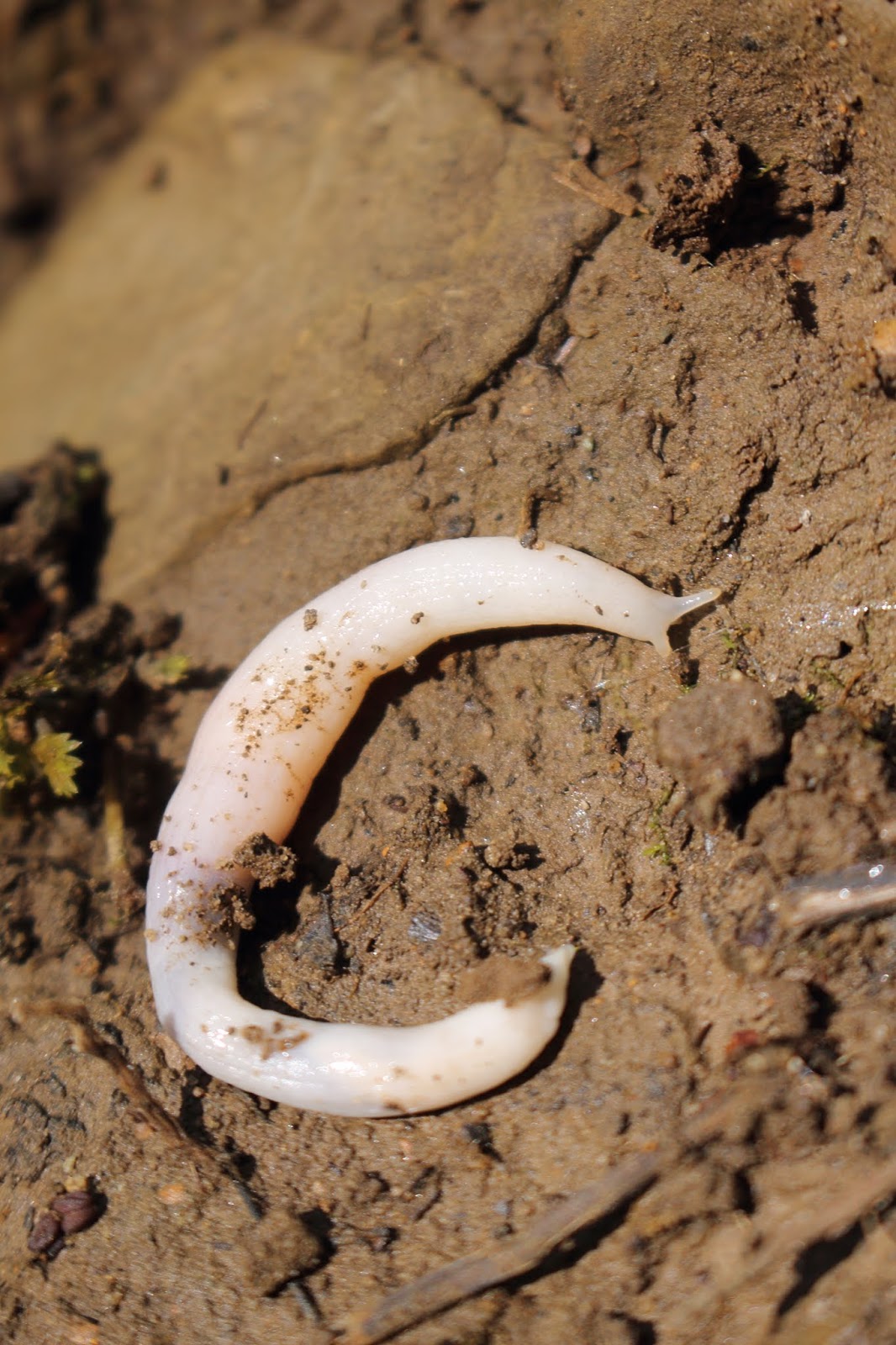
From a road bridge over the Afon Lwyd a footpath snakes steeply through the tree canopy complete with its underlying geology of carboniferous limestone. A ghost slug stopped me in my tracks. This milky white mollusc is unmistakable. Interestingly I've recorded this recent coloniser previously on the outskirts of Pontypool Park, here too close to the Afon Lwyd. Onward through the woodland, passing a flowering cherry tree and a number of path side field maple, birdsong was pronounced. Nuthatch, chiffchaff, willow warbler and blackcap were all in fine voice.

At the top of the climb the path emerged onto what we knew as youngsters, as the tramline. This is a remnant of industrial activity from bygone days. A track that was used to move limestone across the valley to sites such a The British ironworks. I paused to catch my breath - much needed for one that is approaching sixty one. Around this intersection I could find bluebell just coming into flower along with ramsons, yellow arcangel and pitnut. A few people passed, including a couple who asked me about butterflies.

From the intersection I took the tramline route north for a while before turning east. This took me into an area of larch clear fell. A tree pipit sang from a tall spindly silver birch before parachuting in full song to a tree with more cover. A lad of a scrambler bike passed heading north. My time was up so I made my way back whence I came. On the way I, paused again, as naturalist often do, to photograph the distinctive leaf mine of the fly Chromatomia scolopendri on harts tongue fern.


Ghost slug

Ramsons

Leaf mine of Chromatomia scolopendri


Related Posts Plugin for WordPress, Blogger...